


{{product.productLabel}} {{product.model}}
{{#if product.featureValues}}{{product.productPrice.formattedPrice}} {{#if product.productPrice.priceType === "PRICE_RANGE" }} - {{product.productPrice.formattedPriceMax}} {{/if}}
{{#each product.specData:i}}
{{name}}: {{value}}
{{#i!=(product.specData.length-1)}}
{{/end}}
{{/each}}
{{{product.idpText}}}
{{product.productLabel}} {{product.model}}
{{#if product.featureValues}}{{product.productPrice.formattedPrice}} {{#if product.productPrice.priceType === "PRICE_RANGE" }} - {{product.productPrice.formattedPriceMax}} {{/if}}
{{#each product.specData:i}}
{{name}}: {{value}}
{{#i!=(product.specData.length-1)}}
{{/end}}
{{/each}}
{{{product.idpText}}}


Transmission frequency range: 156 MHz - 161 MHz
Reception frequency range: 156 kHz - 161,000 kHz
... Small but mighty. The Compact Ray 53 Class D VHF incorporates DSC and an internal GPS receiver. COMPACT VHF RADIO WITH GPS Raymarine’s Ray53 radio is big on features and performance. Ray53 is a VHF marine radio with Class D Digital Selective Calling ...
Raymarine


Output power: 30 W
Number of channels: 72 unit
Transmission frequency range: 156 MHz - 162 MHz
... The Ultimate 5-in-1 Tool VHF Radio, GPS, AIS, Loud Hailer, NMEA2000 and DSC Calling (Black Box Type) Features Built-in AIS receiver When connected to an MFD or Chart Plotter that can read and display AIS data, the built-in AIS receiver will guarantee ...
Furuno


Output power: 1, 25 W
Transmission frequency range: 156 MHz - 157 MHz
Reception frequency range: 156 MHz - 163 MHz
Stay safe and connected with this VHF marine radio featuring a sleek design with removable fist mic, Class D DSC functionality, and built-in GPS. Keep track of nearby AIS-equipped vessels with an integrated AIS receiver, and add up to two optional wireless ...
B & G
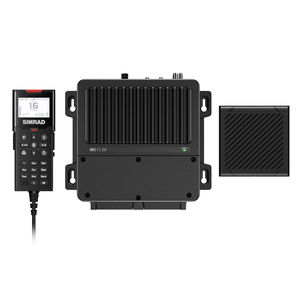

Stay connected and navigate safely with the Simrad RS100 VHF marine radio. The standard package includes one wired handset and one external speaker but supports up to eight handsets (four wired and four wireless) and four external speakers for vessel-wide ...
Simrad Yachting
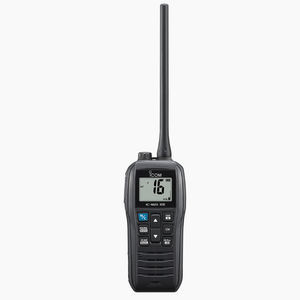

Transmission frequency range: 156 MHz - 161 MHz
Reception frequency range: 156 kHz - 163,000 kHz
Weight: 228 g
... Buoyant VHF Radio with a Fresh Design for Marine Adventures The IC-M25EURO EVO is an upgraded model of the extremely popular IC-M25EURO floating VHF marine handheld transceiver. The IC-M25EURO EVO is designed with an improved grip texture for easier ...
Icom
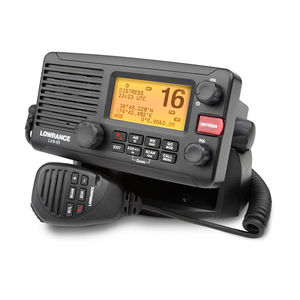

The Link-8 marine VHF radio combines reliable performance with critical safety features for complete communication anywhere on the water. The Link-8 features NMEA 2000 connectivity, a built-in dual channel AIS receiver with AIS plot functionality, dual ...
Lowrance


... A Feature-rich Handset that Raises the Bar on Toughness Iridium Extreme® combines market-leading toughness with an unmatched feature set including location awareness and a fully integrated SOS button with emergency response service — all in one compact ...
Iridium


... Measuring transducer for temperature (thermocouple). Simple application; for harsh environments. Compact design for mounting side by side. Fine adjustment of the measuring range via sealed integrated trimming potentiometer. Operating status indication ...
NORIS Group GmbH
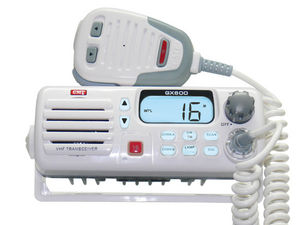

... Built to operate in the 156-163 MHz Marine Band, and designed to compliment the GME GR200 AM/FM radio in size and design providing a symetrical fitout to any vessel's instrument panel. Packed full of features, the GX600's rugged diecast powder coated ...
GME electrophones
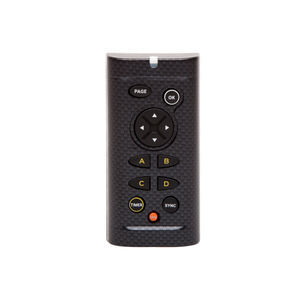

... This wired remote control incorporates the A-B-C-D keys to directly access pre-programmed configurations. For example, after a start in configuration A, a simple press of the B key will switch all Multidisplay with the useful channels for upwind. The ...
nke Marine Electronics
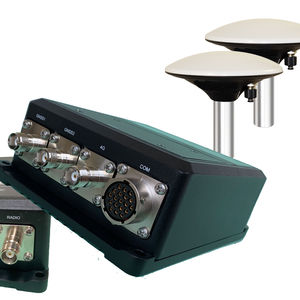

... 1 cm Position, 0.01° Heading Capable Professional RTK receiver suitable for USVs, dynamic positioning, hydrographic and scientific applications Dual marine grade antenna for precise heading calculations FCC and CE certified Built-in web user interface ...
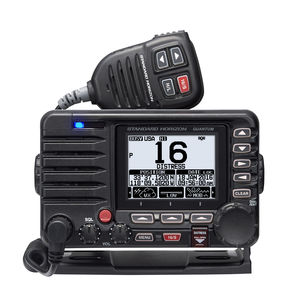

... Introducing the all new Quantum GX6000 Commerical Grade Fixed Mount VHF with NMEA2000 and Integrated AIS receiver Integrated AIS Receiver** AIS / AIS SART target display: MMSI, Call Sign, Ship Name, BRG, DST, SOG and COG NMEA2000 and NMEA0183 compatible Programmable ...
Standard horizon

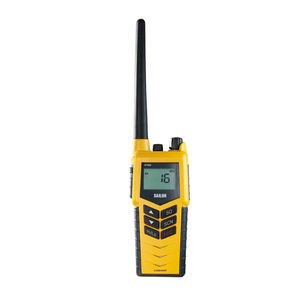

... SAILOR SP3520 Portable VHF GMDSS is fully approved for GMDSS use. GMDSS approved SAILOR SP3520 Portable VHF GMDSS comes with the international channels that are required for a portable GMDSS VHF, so is fully approved for use as a part of your GMDSS ...
Cobham
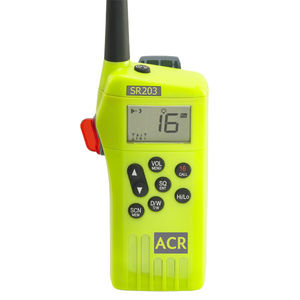

Output power: 2.5 W
Number of channels: 16 unit
Weight: 0.4 kg
The SR203 VHF Handheld Survival Radio is an FCC approved device that’s built for all marine applications. Its digital display and control buttons are backlit, making the device easily operable in dark environments. If you find yourself in need of some ...


... This rugged directional receiver provides range and bearing to the ATT-400 series of transponders or acoustic pingers operating from 8kHz to 45kHz. Designed for small boat operations, the STI-350 uses a directional hydrophone and adjustable staff assembly ...
RJE International Inc.
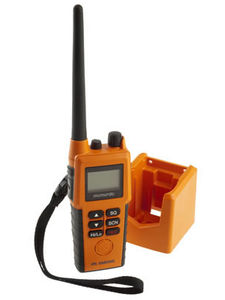

... The R5 is the ideal solution to meet the stringent GMDSS safety standards for compliant vessels. More than just an emergency radio, the R5 is packed with features, can be easily used even when wearing gloves and its rugged waterproof design means it’s ...
McMurdo
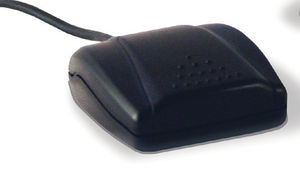

... The Nobeltec USB GPS 9P Portable is an easy-to-use, affordable and feature filled GPS solution. The GPS module receiver will track up to 20 satellites at a time while providing navigation updates once every second (1Hz). USB interface for plug-and-play ...
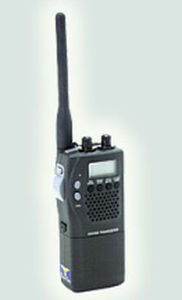

... A2E Navy 01 VHF/FM radio. Complete with: NI-CD battery pack, battery charger, removable antenna, belt clip ...
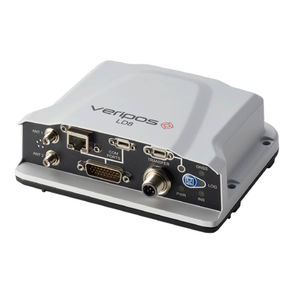

The LD8 is a high-precision GNSS receiver that provides reliable and accurate positioning. The compact and lightweight receiver offers industry-leading GNSS multi-constellation heading and positioning data for dynamic environments. L-Band signals can ...
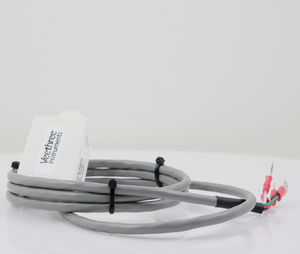

... The Veethree GPS Receiver is the most accurate solution for converting an existing electrical speedometer into a GPS speedometer. Standard GPS with 1-second (1Hz) update rate that outputs NMEA 0183 info. Fast update GPS with 1/10-second (10Hz) update ...
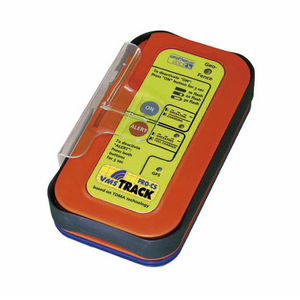

... Real-Time vessel & object monitoring by VHF The system allows persistent locating and monitoring of vessels and moving objects in a special area via VHF technologies. The vmsTRACK-PRO-CS is working with CSTDMA Class B transmission functionality. CSTDMA ...
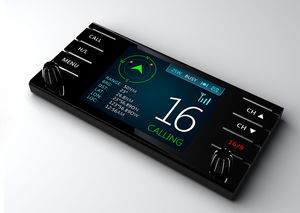

With an extremely bright OLED touch screen display and the next generation electronics of Aveo aviation radios now available in marine bands, the TouchComTM is also the highest wattage output VHF marine radio in the world.
Aveo Engineering
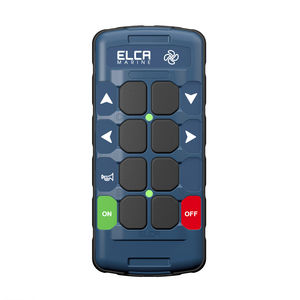

... MINI+ (Plus) is a compact push-button panel that allows remote control of a wide variety of controls in the boat, such as: anchors, gangways, tenders, sails, propellers, lights, sirens, propellers, individually or by groups. Models with 2-4-6 single-step ...
ELCA Radiocomandi


Output power: 2.5, 1 W
Number of channels: 21 unit
Height: 141 mm
... The Ocean Signal range of survival craft VHF hand portable radiotelephones exceed the requirements of IMO, SOLAS and GMDSS. Lithium Polymer rechargeable battery option available with rapid charger, for everyday normal use Fully waterproof, even 40C ...