|
|
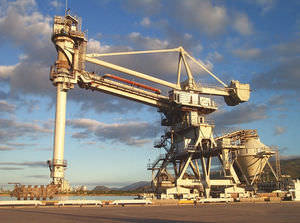
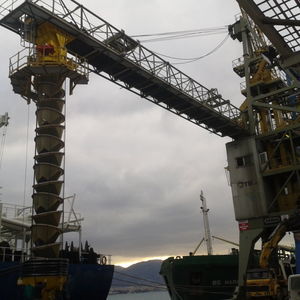
Radial quadrant, shuttling-boom ship-loader (2 units) for the Fundy Gypsum project, Canada.
Features and values
Radial travelling on rails.
Boom with slewing, shuttling and luffing function.
Material transfers from the feed chute at the pivot structure to the boom tip.
Slewable chute and spout for efficient material distribution.
Suitable for short ship-loading time because of tidal action.
|
|
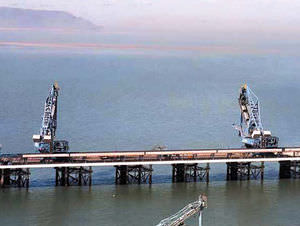
Radial quadrant, shuttling-boom ship loader (2 units) during erection for project Qatar Ras Lafan.
Features and values
Radial travelling on rails.
Boom with slewing, shuttling and luffing function.
Material transfer from the feed chute at the pivot structure to the boom tip.
Slewable chute and spout for efficient material distribution.
Suitable for short ship-loading time because of tidal action.
|
|
|
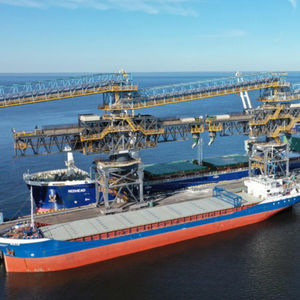
The quadrant-type shiploader features a fix bridge-type structure that pivots around a kingpin-type support, while the seaward side is supported on a series of bogies that travel along a circular rail. A telescoping boom traverses the top of the main structure, complete with telescoping loading chute and spoon. The extent of travel of the telescoping boom depends on the angle of rotation of the main structure to ensure access to each hold of the ship. By pivoting at the tail end, the shiploader is afforded access to the entire length of the ship. Rather than incorporating a shuttle conveyor, the entire upper structure travels on the fixed lower bridge section of the shiploader. The combination of bridge rotation and boom travel allows the operator to access all areas of the ship's hold.
|
|
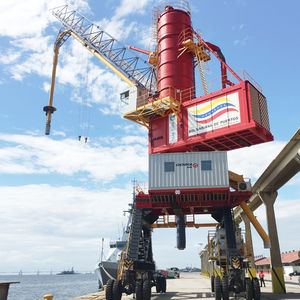
There are three models of Nordströms pneumatic conveying available:
Road mobile for transport on public roads, capacities up to 350 t/h
Port mobile for restricted movements inside a harbour area or similar, capacities up to 800 t/h
Stationary for installation on fixed supports, capacities up to 1200 t/h
|
|
Features:
- Mobile on rubber wheels, with or without booms
- Capacity up to 180 t/h grain
- Power supply by Diesel engine or Electric motors
- For Suction only or Suction / Pressure conveying
- For Unloading of Ships, Barges, Trucks etc.
- For Loading of Trucks, Waggons, Chain/Belt conveyors, Silos etc.
- Use on quay or on ship's deck
|
|
STATIONARY SHIPUNLOADER
Features:
- Fixed on platforms, towers or at silo walls
- Boom length up to 30 metres
- Capacity up to 600 t/h grain
- Feeding silo / quay conveyor
|
|
We build the largest pneumatic ship unloaders (up to 1,500 t/h) for the aluminium industry, serving many smelters around the globe. Ship loaders, as well as combined ship loaders/unloaders, are offered for a wide variety of bulk materials.
We are also a trusted supplier of integrated harbour solutions, including:
- Dock conveyors
- Storage facilities
- Feeding systems
- Extraction systems
- Pneumatic conveying systems
|
|
Stationary ship loaders:
- Application: Loading of ships with grain, oilseeds and derivatives. Stationary service on piers.
- Layout: The layout and design of the installation are customized to suit the customer's specific requirements and the local conditions.
- Customer value: Efficient and cost-effective solution; Single loading or multiple loading through several loading lines; High boom flexibility eliminates the need for time-consuming relocation of the ship
|
|
|
Design and supply of a combined pneumatic/gravity ship loading system for cement at the Okke plant in Korea for Halla Cement.
|
|
Siwertel ship loaders:
MacGREGOR offers a range of ship loaders for dry bulk commodities, also for dusty materials like cement, alumina, fly ash and clinker. The loaders focus on high capacity, environment-friendly operation. With ship loaders based on screw, aeroslide or belt conveying technologies MacGREGOR is able to supply the best suited solution for loading of any type of dry bulk materials and annual throughput.
Among the advantages are:
- Totally dust and spillage free operation with special loading spouts
- Compact design & low weight compared to conventional loaders
- High loading capacities, up to 3000 t/h
- Suitable for ships of up to 80,000 dwt
- Loading of for example cement and clinker is possible with the same unit
|
|
NEUERO ship loaders (shortly shiploader) are machines for loading ships with bulk material have common design concept and function, but they often vary in implementation to correspond to:
- Spatial limitations of the quay of operation (fixed, traveling, etc.)
- Mean of receiving the transported material from silos (quay belt conveyors, elevators, etc.)
- Power supply (port electricity, own genset, etc.)
selected dust supression solution
- Sizes of ships to load
- Desired cpacity (depends on the capacity of existing feeding conveyors)
- Up-to-date technological innovations
|
|
Slew type ship-loader for the Cape Lampert project, Australia.
Features and values
Longitudinal travelling on rails.
Boom with slewing and luffing function.
Capable of loading ships on either side of the wharf.
Equipped with head chute deflector plate to direct and degrade the ore stream during loading of the ships.
|
|
Slew type ship-loader for the NeWeipa project, Australia.
Features and values
Longitudinal travelling on rails.
Boom with slewing and luffing function.
Capable of loading ships on either side of the wharf.
Discharge chute is equipped with a cascade flow chute to provide dustless transfer.
|
|
Tenova TAKRAF’s ship loaders load the most different bulk materials into sea or river vessels via a conveyor boom.
According to the pier design/ configuration Tenova TAKRAF supplies stationary or travelling ship loaders with a range of boom and chute combinations.
|
|
Ship & barge loaders
Metso Minerals has designed and supplied a wide range of barge and ship loaders.
From river and gulf barge loaders to linear ship loaders, we can provide machines that can load 150,000 DWT ships at rates up to 11,000 tons per hour.
|
|
Portaload Mobile ship loaders:
- Application: Loading of ships with grain, oilseeds and derivatives. Can travel along piers on rails or tires.
- Layout: The layout and design of the installation are customized to suit the customer's specific requirements and local conditions.
- Energy supply: Electric power through cable
- Customer benefit: Flexibility; Combination of travel alongside ships and boom movements ensures efficient loading of ships of a wide variety of sizes.
|
|
Longitudinal type ship-loader for the Gladstone project, Australia.
Features and values
Longitudinal travelling on rails.
Boom with shuttling and luffing function.
Discharge chute equipped with a Cascade flow chute to provide dustless transfer.
Implemented using a special dedusting system.
|
|
Slew type ship-loader for the port of Qinhuangdao, China.
Features and values
Longitudinal travelling on rails.
Boom with slewing, shuttling and luffing function.
Vertical telescopic chute with electric winch operation.
Slewable loading spout for efficient material distribution.
|
|
Longitudinal type ship-loader for the Finucane Island project, Australia.
Features and values
Longitudinal travelling on rails.
Boom with shuttling and luffing function.
Equipped with special discharge hood around the head pulley to contain any dust generated.
|
|
Slew type ship-loader for the Dampier project, Australia.
Features and values
Longitudinal travelling on rails.
Boom with slewing and luffing function.
Capable of loading ships on either side of the wharf.
Equipped with adjustable deflector chute to deflect the material flow and to enable distribution of the material within the ship.
|
|
Many different developments for all capacity ranges and areas of application permit the selection of the most economic systems: travelling shiploaders with slewing and luffing booms, slewable systems with fixed pivot points and radial tracks, radial shiploaders, special designs or the most recent combined shiploader / stackers.
Thus, subject to individual requirements, bulk goods find the most economic route from delivery via intermediate storage to the vessel.
|
|
|
6000t/h SHIPLOADER FOR HUANGHUA PORT,CHINA
|
|
Those illustrations are only an example where the products are handled to the pier by a wharf conveyor and into an inclined conveyor on the loader.
Passing through the central head of the loader, the products are moving towards the ship holds thanks to telescopic belt conveyors and then they will fall into the telescopic loading pipe into the holds.
The telescopic conveyors are rotating on a slewing ring in order to allow continuous and uniform loading operations off of the entire hold.
|
|
Longitudinal type ship-loader for the project Calcutta Port, India.
Features and values
Longitudinal travelling on rails.
Boom with shuttling and luffing function.
Equipped with vertical telescopic loading chute.
|
|
| ... products without information |
| |
|
|