|
|
|
Based on the most up-to-date technology accumulated through its wealth of experience in manufacturing diesel engines and a wide variety of precision machinery, HHI produces exhaust gas turbochargers:ABB's TPL/VTR type, and MHI's MET type for turbocharging diesel engines under a technical tie-up with ABB Turbo System Ltd. of Switzerland and Mitsubishi Heavy Industries Ltd. of japan, respectively who themselves have more than 40 years' experience in the field of designing and manufacturing turbochargers.
|
|
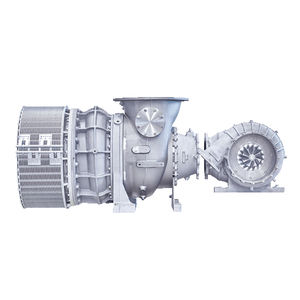
For high output engine applications - up to 30 000 kW engine output (per TC) - MAN Diesel develops and produces a wide range of axial turbochargers. In 2002 the company presented a completely new generation, the TCA series, featuring amongst other technical highlights a completely new system of compressor mounting.
MAN axial flow turbochargers are suitable for two-stroke and four-stroke applications in MDO, gas, biofuel and heavy fuel operation.
|
|
|
The new TCR turbochargers were designed to comply with the special demands made on HFO, MDO, biofuel and gas engines. They cover the complete range of possible applications, like propulsion and stationary engines, GenSets as well as traction engines, wich are subject to the strictest requirements with regard to size and weight. As compared to the previous generation, these new turbochargers offer the advantage of increased compactness and less weight without any concessions regarding efficiency and performance.
|
|
The reliable and maintenance friendly design of the NA/S and NA/T9 series with inboard plain bearings and turbine casings without cooling water, set and still sets an example to the turbocharger industry.
For engine outputs from 1,650 to 24,500 kW per turbocharger
Maximum pressure ration 4.5
Suitable for heavy fuel, diesel oil, biofuel and gas operation
Axial flow turbine
Waterless design NA/S and uncooled hot-gas casings NA/T9
Inboard plain bearings
Lubricated by the engines lube oil system
Easy maintenance
Market introduction 1992
NA/S/T9 series technical data
Turbocharger Project Guides
|
|
|
|
|
|
|
With the new TCA series we have refined the proven technology of the most successful NA series. The integrated design simplifies installation on the engine and maintenance becomes easier than ever before. Advanced materials allow for increased lifetime. The TCA sets the new standard for axial turbochargers and is featuring following benefits:
For engine outputs from 2,100 to 30,000 kW per turbocharger
Maximum pressure ratio of 5.2
Inboard bearing arrangement
High performance floating bearings for minimised mechanical losses and optimised damping behaviour
Newly developed compressor wheel with reduced noise emission and increased efficiency
Compressor wheel change with basic tools and no need of rebalancing the complete rotor
Thrust bearing inspection without shaft removal
Easy replacement of individual turbine blades
Integrated oil piping, sealing air and venting system for simple installation to the engine
Entirely water-free design
Integrated containment area
Reduced number of parts
Market introduction 2002
|
|
The NR/S basically follows the advantageous design principle of the NA/S series, only equipped with a radial turbine instead of an axial turbine. By the comparably simple design of the cast radial turbine, the NR/S series becomes the most economical choice for heavy fuel oil engines in the wide range from 450 kW up to 5 400 kW engine output per turbocharger without any compromise in reliability and performance.
For engine outputs from 450 to 5 400 kW per turbocharger
Maximum pressure ratio 4.5
Suitable for heavy fuel, diesel oi, biofuell and gas operation
Radial flow turbine
Uncooled casings
Inboard plain bearings
Lubricated by the engines lube oil system
Easy maintenance
Market introduction 1995
NR/S Series technical data
Turbocharger Project Guides
|
|
|
|
|
|
|
The new TCR turbochargers were designed to comply with the special demands made on HFO, MDO, biofuel and gas engines. They cover the complete range of possible applications, like propulsion and stationary engines, GenSets as well as traction engines, wich are subject to the strictest requirements with regard to size and weight. As compared to the previous generation, these new turbochargers offer the advantage of increased compactness and less weight without any concessions regarding efficiency and performance. Advanced materials ensure extended service lives and easier maintenance. The TCR is a completely redesigned turbocharger with:
Engine outputs from 390 to 6,700 kW
Maximum pressure ratio of 5.2
Optimised compressor and turbine wheel for increased efficiency
Constant and pulse pressure turbocharging
Low moment of inertia for best dynamic behaviour
New compressor wheel fixation for easy servicing
Uncooled casings
Pipeless design with integrated oil inlet and oil drain
No sealing air required
Market introduction 2004
|
|
| ... products without information |
| |
| ... products without information |
| |
|
|
|
|
|
Over 80 years ago this ship's propulsion system, the only one of its kind in the world was developed by Voith from an idea by the Austrian engineer Ernst Schneider. It allows thrust of any magnitude to be generated in any direction quickly, precisely and in a continuously variable manner. It combines propulsion and steering in a single unit.
This solution is as convincing as it is straightforward: on the Voith Schneider Propeller, a rotor casing which ends flush with the ship's bottom is fitted with a number of axially parallel blades and rotates about a vertical axis. To generate thrust, each of the propeller blades performs an oscillating motion about its own axis. This is superimposed on the uniform rotary motion.
Blade excursion determines the amount of thrust, while the phase angle of between 0° and 360° determines its direction. As a result, the same amount of thrust can be generated in any direction, making this the ideal variable-pitch propeller. Both variables - the magnitude and the direction of thrust - are controlled by a mechanical kinematic transmission.
|
|
The 4.5L four-cylinder engine is offered as either a propulsion or gen drive engine in either keel cooled or heat exchanger configurations. The engines are either turbocharged, non-aftercooled or turbocharged with jacket water aftercooling. The propulsion engines feature constant power to 400 rpm below rated speed, making these engines an excellent choice for launches, work boats, trawler yachts, and patrol craft.
Ratings M3 M2 M1
Rated Power--hp (kW) 135 (101) 121 (90) 107 (80)
Rated Speed--rpm 2600 2500 2400
Low Idle Speed--rpm 650 650 650
Peak Torque--lb-ft (N.m) 352 (477) 330 (448) 310 (420)
Peak Torque Speed--rpm 1800 1700 1600
|
|
The 6.8L six-cylinder engine is offered as either a propulsion or gen drive engine in either keel cooled or heat exchanger configurations. The engines are either turbocharged, non-aftercooled, turbocharged with jacket water aftercooling or turbocharged with sea water aftercooling. The propulsion engines feature constant power to 400 rpm below rated speed, making these engines an excellent choice for launches, work boats, trawler yachts, and patrol craft.
Ratings M3 M2 M1
Rated Power--hp (kW) 201 (150) 178 (133) 158 (118)
Rated Speed--rpm 2600 2500 2400
Low Idle Speed--rpm 650 650 650
Peak Torque--lb-ft (N.m) 511 (693) 473 (641) 445 (604)
Peak Torque Speed--rpm 2000 1900 1800
|
|
| ... products without information |
| |
|
The Turbo Meter provides uncommon accuracy, sensitivity, and pocket-sized convenience. It is based on the principle that a freely turning turbine will rotate at a speed directly proportional to the wind speed. To insure maximum sensitivity and accuracy, the turbine is suspended on sapphire jewel bearings, and its rotation is sensed by an infrared light beam which adds no friction. The resulting signal is processed electronically by an LSI (Large Scale Integrated) circuit for improved reliability and reduced size
|
|
Patented in-line design - provides ventilation for engine compartments, galleys, bilges, and heads. Mounting feet allow vertical or horizontal installation in confined spaces. Install with #10 fasteners. Individual carton includes 2 tie straps. All are CE certified. 16-gauge tinned and caulked copper wire leads with optional MP1 molded rubber connectors.
- Nickel-plated motor can for corrosion resistance
- Stiffening ribs to reduce housing distortion
- Motor cap to seal wires and motor for water resistance
|
|
The NEW Slingshot TURBO3 has evolved past traditional bow kites to incorporate our delta style canopy/LE configuration. Riders of all abilities will discover a 4 line bow kite that delivers all the requirements of unmatched range, instant 100% de-power, safety and instant re-launch ability. Just ask the insiders that work at Slingshot what they ride.
"Anyone looking for unmatched flexibility to suit their personal style or preferences needs to fly this kite and find out for themselves why it's the leading all around performer. The TURBO3 has the finest combination of ease of use and performance." Amery Bernard, Slingshot Sports Kite Designer.
"The Turbo series has made kiteboarding fun again. Simplicity is my big deal. The TURBO3 not only makes it fun, it also gives me more flexibility and meets my basic needs. Easy set up, a solid hands on feel at the bar to control power, and finally peace of mind because of its built in safety." Jeff D. Logosz, Slingshot Sports President.
|
|
|
|