|
|
|
|
6.50 m 21' 4"
|
|
|
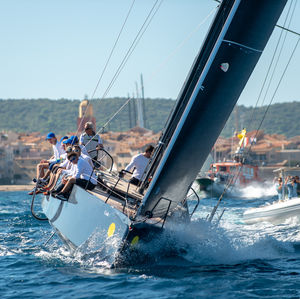
After 15 years of experience in the construction of mini 6.50, Structures is proud to present the next generation of the 6.50 mini. In close colaboration with the Groupe Finot we have conceived a model to succeed the legendary POGO. The Pogo 2 can already be deemed a worthy succesor due to the fact that three Pogo 2 finished in the top three places of the 2003 Transat 6.50.
To achieve the best performance and keep weight to a minimum we have used highly performant materials combined with state of the art fabrication processes which allow us to fabricate the decks in a vacuum sealed environment and guarantee firm compacting of the glass fabric.
The stability, speed and security that the Pogo 2 affords are characteristics that are necessary for offshore racing but also allow for an enjoyable, emotion filled sailing experience.
|
|
|
|
6.50 m 21' 4"
|
|
|
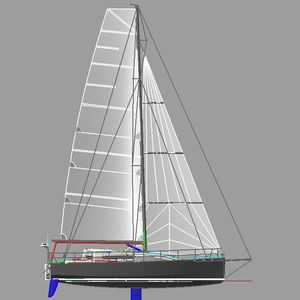
TipTop is a « mini-transat » which fits in the 650 mini serie class.
As a multi-use sailboat, it has been designed for a racing-only or a racing-cruising program.
Large double rudders help to keep stability and flawless control in all sailing modes and conditions. Keel and rudders have been optimized for upwind route and light trail.
Internal lay-out, simple and basic, features movables navigation table and kitchen, 2 lateral seats to relax windward, a fore double bunk and 2 aft berths.
Fractioned rigging offers deck-stepped mast, 2 crosstrees levels and runners, and a trimable outrigger to gybe from cockpit.
TipTop is available either with racing or cruising fitting:
The racing version offers a high level of equipment:
top-quality mylar foresails, 2 spinnakers and 1 genaker, outstanding electronic, etc.
The cruising version suggests a large choice of equipment according to every budget and program.
Lenght : 6,50m Main 26m²
Width : 3,00m Genoa 19m²
Light weight: 950 Kg Solent 14m²
Lead bulb: 440 Kg Spi maxi 80m²
Fixed keel draft : 1,60m Spi medium 50m²
Genaker 28 m²
|
|
|
|
7.50 m 24' 7"
|
|
|
As a multi-use sailboat, it can be used for day outings as well as longer range trips owing to its remarkable seaworthiness comparable to that of a mini-transatlantic sailboat.
It favours safety and performance.
Onboard comfort is not neglected; it offers a separate head and a choice for positioning the kitchen either next to the mast bulkhead or in the rear.
The taunt lines and double rudder guarantee stability and perfect control in all sailing modes.
Regatta fans will choose a classical spinnaker for a favourable rating and gliding enthusiasts will opt for the asymetrical spinnaker on trimable outrigger.
Optional carbon mast offers a wide range of sail options.
The low-lying lead ballast provides excellent stiffness, a mark of safety and performance. The liftable keel version eliminates having to choose between performance and reduced draught.
CHARACTERISTICS
Length: 7,50m MS: 23m²
Width: 2,80m Solent 17m²
Light weight: 1,30t Spinnaker: 50m²
Net weight: 1,90t
Fixed keel draft 1,80m
Liftable keel draft (optional) 1,80m/1,10m
Engine: 6hp HB
|
|
|
|
8.50 m 27' 11"
|
|
|
It is 6 years now since we launched the Pogo 8.50, which was elected « Boat of the Year » in 2001 by Voile Magazine and distinguished itself during many races like La Transquadra (first place in solo in 2001, second and third places in 2003, fifth, sixth and seventh in 2005, and there were 17 Pogo 8.50 on the departure line) or during the Ostar in 2005 with Lionel Reigner (who won the Jester Trophy and “Petit Bateau” cup which conccerns the first sailing ship under 35’)
This boat was designed for the racing sailors who want a mixed-programme sailing boat. The Shipyard and the architect created a sailing boat able to take a family in cruise and to win deep sea races in solo or with a little crew.
|
|
|
|
9.14 m 30' 0"
|
|
|
The Open 30 Class was conceived in 2000 to fill the gap in the market for short handed offshore racing boats between the Open 6.5 and the Open 40. The class is thriving across the Atlantic in South America (the head office of the Open 30 Class Association is in Argentina) and in North America and Europe. Some of the most innovative designers have applied their magic to this class which is designed according to a "box rule".
The rules of the Open 30 Class are open; anything not specifically prohibited, limited or imposed, is permitted. The rules are administered by the Open30 Class Association. Measuring is self administering. The owner of the boat shall be responsible for submitting the correct information to the Open30 Class Association. The basic class rules are:
LOA not to exceed 30 ft (9.14m) This measurement excludes all appendices and all items of fittings.
In light procedure, the draught is limited to 2.5m from the flotation plane
Maximum beam, including all deck fittings shall be no more than 3.5m
The measurement of the bottom of the keel to the top of the highest sail shall to be more than 17.5m
Freeboard average to be not less than 0.90m
Cabin top is mandatory with a minimum volume specified.
The structure of the boat to withstand the forces of races classified by ORC in category 1. Structural calculations to ISO 9000 norms.
The total flotation reserve not to be less than 2sqm. Core material to be included in calculation.
Escape hatch in the transom is required.
Water ballast tanks and adjustable keel arrangements are allowed.
AVS not less than 125 degrees.
Materials with a greater density than lead are prohibited.
The VG Open30 was designed by Van Gorkom Yacht Design based in Newport, RI. Van Gorkom predicts a speed of 19 knots in 25 knots of wind at 120 degrees true wind angle in his VPP analysis of his Open 30 design.
At about 14 knots of true wind speed, the Van Gorkom design will start breaking loose and the boat should start planing by 20 knots of wind at an estimated boat speed of between 16 and 18 knots. She has a displacement/length ratio of 128 and a sail area/displacement ratio of 34 upwind and a massive downwind SA/DSPL ratio of 82.
|
|
|
|
12.18 m 40' 0"
|
|
|
When we began development of the new Pogo 40 with Jean-Marie Finot and Pascal Conq, we asked ourselves one simple question : Why were speed and cruising always on opposite ends of the spectrum. Why couldn´t a cruise be done at more than 6 knots...?
Our goal was to design a boat capable of achieving a compromise between fast racing and long distance cruising. We decided that a 40 foot (12.20 m) boat was the ideal length. A length that would be manouverable, even for amateurs.
And so the Pogo 40 was born...Designed to travel long distances at high speeds. A boat that is simple to sail even with a reduced number of crew. A serious boat which is easy to maintain. A trustworthy boat, sure and unsinkable.
With the new Pogo 40 you can line up at the start of any one of the international offshore races, such as the Route de Rhum or the English Transat or take you family on a long distance trip across the Atlantique during a sabbatical year.
|
|
|
|
12.18 m 40' 0"
|
|
|
JPK 40
Last generation of class 40, the JPK as well as possible exploits the framework of the gauge with an estimate of weight perfectly control, a report/ratio of ballast to the maximum of stability and a very elaborate hull.
Implemented sophisticated of infusion for construction but cost controls, the JPK 40 remains faithful to the spirit of Class 40.
|
|
| ... products without information |
| |
|
|
6.50 m 21' 4"
|
|
|
|
|
|
6.50 m 21' 4"
|
|
|
|
|
|
9.50 m 31' 2"
|
|
|
|
|
|
12.18 m 40' 0"
|
|
|
|
|
|
14.00 m 45' 11"
|
|
|
Ocean Sprite GP 46 is a craft which is characterized by its tapering and elegant line, very suitable for sailing but with an optimal use of the internal volume.
The materials used are amongst the most technologically advanced, in order to guarantee lasting wear and minimum maintenance. The deck plan, inspired with no compromise directly by the decks of ocean going regatta boats, can be personalized.
The generous sailing plan, the water lines and the light displacement make for excellent performance in all conditions. The righting moment and stability diagram have values at the very top of the market.
The aluminium mast (on request in carbon-fiber) has two swept spreaders with non structural runners to guarantee maximum manouvrability and safety. In the Race versione, the rolling genoa is manouvrable from the cockpit using the service winches on the deckhouse rather than with the traditional route which leads to the lateral winches, making it possible to manoeuvre the rolling genoa without having to free the winches used with the sheets.
|
|
| ... products without information |
| |
|
|
12.20 m 40' 0"
|
|
|
|
|
|
23.20 m 76' 1"
|
|
|
With an overall length of just over 23m Ocean Phoenix represents an impressive statement for the capabilities of modern composite materials, combining strength, lightness, stiffness and durability in both hull construction and interior structures and detailing.
The Yacht features an impressive list of innovative ideas to make sailing at speed a pleasure for all on-board, with particular consideration given to advanced electronics and the correct positioning of all sail equipment.
|
|
|
The Forespar® OceanRacer™ has been the choice of offshore and inshore racing helmsmen for years. Major world events see the OceanRacer™ on top boats from every port. This year, these extensions have been optimized with the addition of a sturdy remote operating trigger and optional StaFAST™ connection.
|
|
|
|