


{{product.productLabel}} {{product.model}}
{{#if product.featureValues}}{{product.productPrice.formattedPrice}} {{#if product.productPrice.priceType === "PRICE_RANGE" }} - {{product.productPrice.formattedPriceMax}} {{/if}}
{{#each product.specData:i}}
{{name}}: {{value}}
{{#i!=(product.specData.length-1)}}
{{/end}}
{{/each}}
{{{product.idpText}}}
{{product.productLabel}} {{product.model}}
{{#if product.featureValues}}{{product.productPrice.formattedPrice}} {{#if product.productPrice.priceType === "PRICE_RANGE" }} - {{product.productPrice.formattedPriceMax}} {{/if}}
{{#each product.specData:i}}
{{name}}: {{value}}
{{#i!=(product.specData.length-1)}}
{{/end}}
{{/each}}
{{{product.idpText}}}


... Mechanical seal serie TDL with lip seal and rubber pipe. ...

... Mechanical frontal seal serie TMF with rubber bellows. ...


... ERCEM seal is a mechanical seal which operate thanks to the friction of the rotating stainless steel ring and static carbon ring. The nitrile bellows fixed to the stern tube with collars 316L provides ...
MAUCOUR FRANCE

... ERCEM GV seal is a mechanical seal which operate thanks to the friction of the rotating stainless steel ring and static carbon ring. The nitrile bellows fixed to the stern tube with collars 316L provides ...
MAUCOUR FRANCE
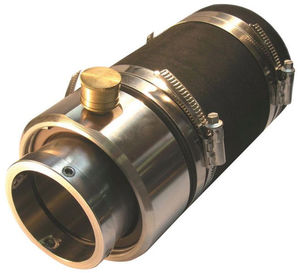
... The GTX seal, manufactured from high performance materials, gives a perfect watertight seal. GTX seal is fitted with a reinforced neoprene hose and stainless steel clamps and is very easy to install. ...
MAUCOUR FRANCE


... The MTM900 propeller shaft seal was created to attack the market of small and medium-sized boats and since many years it has been the first choice of the main world Yachts shipyards. Simple, reliable, ...
Microtem

... It is surely the more resistant propeller shaft seal on the market. The MTM400, in comparison with all the existing propeller shaft mechanical seals, ...
Microtem
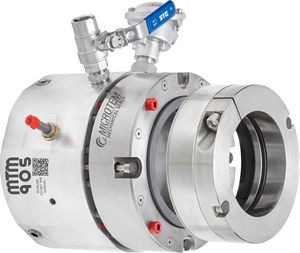
... It is the most advanced mechanical seal alternative to the classic rubber bellows systems. The MTM905 propeller shaft mechanical seal is the first system designed for ...
Microtem
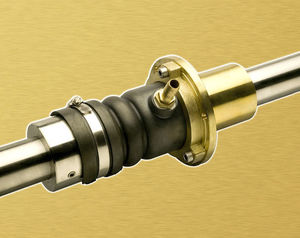

... generally fixed to the packing box; the rotating part is fixed to the shaft and turns with it. Thus there is no wear on the shaft: in fact the true seal is found perpendicular to the shaft ...
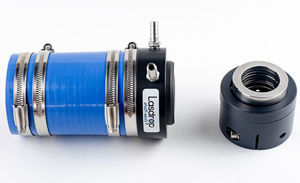

... premium seals you will find on the market today. Gen2 Innovations from Lasdrop Our Gen2 Shaft Seal is a revolutionary seal that combines some of the highest quality marine grade shaft ...


... the SureSeal® when shaft misalignment occurs. As a result, lip seal and bearing life are extended. Lip Seal Replacement The SureSeal® design incorporates a removable front cap which improves access ...
Tides Marine
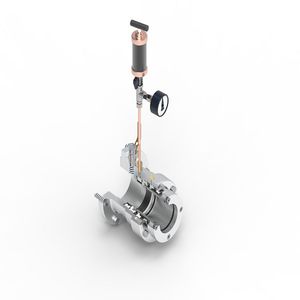

... bearing is positioned right after the seal. The stand by seal is an by oil pressure inflated rubber seal that can be used in case of emergency. When maintenance on the seal is required, ...
Poseidon Propulsion


... The TOR Mechanical seals are high quality and precision seals and also easy to install and maintain. The TOR sealing system is given by the perfect planar contact between the AISI 316 stainless steel ...
TOR MARINE SRL


... developed a new commercial model of our famous Blue Water Shaft Seal. Commercial boat operators require a shaft sealing system that can be serviced without having to slip their boat and remove the shaft ...
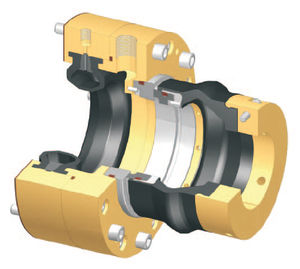

... exceptional efficiency Pneumostop stand-still seal allows you to inspect the shaft and the seal without removing the ship from the water Simplan seal is fitted precisely to the ...


... are using our own AxiSeal mechanical shaft seal. The AxiSeal is maintenance free and allowed to handle axial shaft movement of ±10mm and radial shaft movement of ±2mm. ...
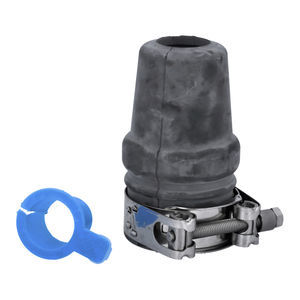

... axial horn gland, without forced cooling, for metal or fiber horns. Suitable for a 25mm shaft and a 43mm outer diameter horn. This gland ensures a tight and durable seal. Constructed with materials resistant to saltwater ...
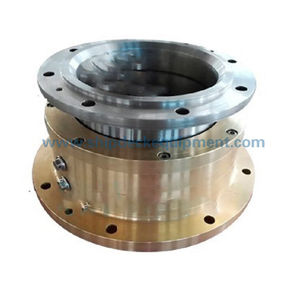

... clamp ring, gas tire seal Diameter range of stern shaft 50-1150mm Diameter of wearproof liner of stern shafts 70-1250mm Lubricating oil working pressure 1-2bar Lubricating oil working temperature ...
the best suppliers