|
|
|
|
6.50 m 21' 4"
|
|
|
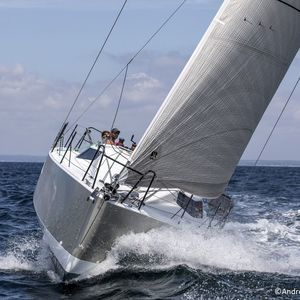
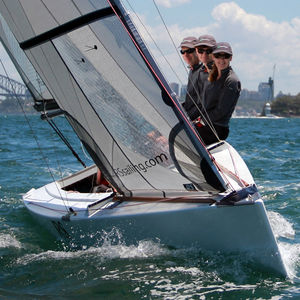
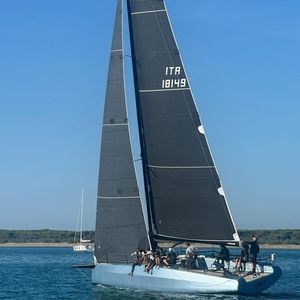
After 15 years of experience in the construction of mini 6.50, Structures is proud to present the next generation of the 6.50 mini. In close colaboration with the Groupe Finot we have conceived a model to succeed the legendary POGO. The Pogo 2 can already be deemed a worthy succesor due to the fact that three Pogo 2 finished in the top three places of the 2003 Transat 6.50.
To achieve the best performance and keep weight to a minimum we have used highly performant materials combined with state of the art fabrication processes which allow us to fabricate the decks in a vacuum sealed environment and guarantee firm compacting of the glass fabric.
The stability, speed and security that the Pogo 2 affords are characteristics that are necessary for offshore racing but also allow for an enjoyable, emotion filled sailing experience.
|
|
|
|
6.50 m 21' 4"
|
|
|
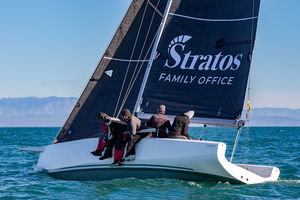
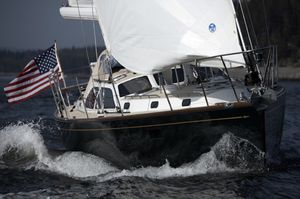
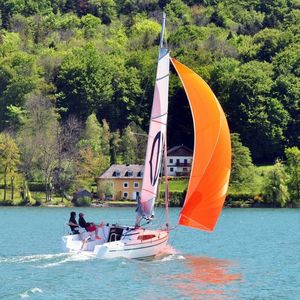
TipTop is a « mini-transat » which fits in the 650 mini serie class.
As a multi-use sailboat, it has been designed for a racing-only or a racing-cruising program.
Large double rudders help to keep stability and flawless control in all sailing modes and conditions. Keel and rudders have been optimized for upwind route and light trail.
Internal lay-out, simple and basic, features movables navigation table and kitchen, 2 lateral seats to relax windward, a fore double bunk and 2 aft berths.
Fractioned rigging offers deck-stepped mast, 2 crosstrees levels and runners, and a trimable outrigger to gybe from cockpit.
TipTop is available either with racing or cruising fitting:
The racing version offers a high level of equipment:
top-quality mylar foresails, 2 spinnakers and 1 genaker, outstanding electronic, etc.
The cruising version suggests a large choice of equipment according to every budget and program.
Lenght : 6,50m Main 26m²
Width : 3,00m Genoa 19m²
Light weight: 950 Kg Solent 14m²
Lead bulb: 440 Kg Spi maxi 80m²
Fixed keel draft : 1,60m Spi medium 50m²
Genaker 28 m²
|
|
|
|
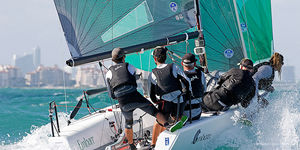
7.30 m 23' 11"
|
|
|
Standard equipment
Hull, white
- Hull infusion laminated,
- Horizontal surfaces in balsa sandwich
- Cast iron dagger board
- Laminated rudder blade
- Dock eye
Deck, white
- GRP – deck infusion laminated
- Horizontal surfaces in balsa sandwich
- Bow stoprails
- 3 mooring eyes
- Steering system
- Laminated rudder blade
- Laminated hand tiller
- Tiller extension
- Main sheet with block and centre fitting in cockpit
- Dogger board winch with crane
- Hiking straps
- Standing rigging
- Boom with accessories
- Genaker boom with accessories
- Companionway door with hinges
- Genaker bag
- Sheets pockets
- Mast transport support
- Boat transport support
- Jib track with cars
|
|
|
|
7.50 m 24' 7"
|
|
|
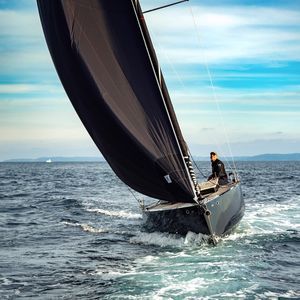
As a multi-use sailboat, it can be used for day outings as well as longer range trips owing to its remarkable seaworthiness comparable to that of a mini-transatlantic sailboat.
It favours safety and performance.
Onboard comfort is not neglected; it offers a separate head and a choice for positioning the kitchen either next to the mast bulkhead or in the rear.
The taunt lines and double rudder guarantee stability and perfect control in all sailing modes.
Regatta fans will choose a classical spinnaker for a favourable rating and gliding enthusiasts will opt for the asymetrical spinnaker on trimable outrigger.
Optional carbon mast offers a wide range of sail options.
The low-lying lead ballast provides excellent stiffness, a mark of safety and performance. The liftable keel version eliminates having to choose between performance and reduced draught.
CHARACTERISTICS
Length: 7,50m MS: 23m²
Width: 2,80m Solent 17m²
Light weight: 1,30t Spinnaker: 50m²
Net weight: 1,90t
Fixed keel draft 1,80m
Liftable keel draft (optional) 1,80m/1,10m
Engine: 6hp HB
|
|
|
|
8.50 m 27' 11"
|
|
|
It is 6 years now since we launched the Pogo 8.50, which was elected « Boat of the Year » in 2001 by Voile Magazine and distinguished itself during many races like La Transquadra (first place in solo in 2001, second and third places in 2003, fifth, sixth and seventh in 2005, and there were 17 Pogo 8.50 on the departure line) or during the Ostar in 2005 with Lionel Reigner (who won the Jester Trophy and “Petit Bateau” cup which conccerns the first sailing ship under 35’)
This boat was designed for the racing sailors who want a mixed-programme sailing boat. The Shipyard and the architect created a sailing boat able to take a family in cruise and to win deep sea races in solo or with a little crew.
|
|
|
|
9.14 m 30' 0"
|
|
|
The Open 30 Class was conceived in 2000 to fill the gap in the market for short handed offshore racing boats between the Open 6.5 and the Open 40. The class is thriving across the Atlantic in South America (the head office of the Open 30 Class Association is in Argentina) and in North America and Europe. Some of the most innovative designers have applied their magic to this class which is designed according to a "box rule".
The rules of the Open 30 Class are open; anything not specifically prohibited, limited or imposed, is permitted. The rules are administered by the Open30 Class Association. Measuring is self administering. The owner of the boat shall be responsible for submitting the correct information to the Open30 Class Association. The basic class rules are:
LOA not to exceed 30 ft (9.14m) This measurement excludes all appendices and all items of fittings.
In light procedure, the draught is limited to 2.5m from the flotation plane
Maximum beam, including all deck fittings shall be no more than 3.5m
The measurement of the bottom of the keel to the top of the highest sail shall to be more than 17.5m
Freeboard average to be not less than 0.90m
Cabin top is mandatory with a minimum volume specified.
The structure of the boat to withstand the forces of races classified by ORC in category 1. Structural calculations to ISO 9000 norms.
The total flotation reserve not to be less than 2sqm. Core material to be included in calculation.
Escape hatch in the transom is required.
Water ballast tanks and adjustable keel arrangements are allowed.
AVS not less than 125 degrees.
Materials with a greater density than lead are prohibited.
The VG Open30 was designed by Van Gorkom Yacht Design based in Newport, RI. Van Gorkom predicts a speed of 19 knots in 25 knots of wind at 120 degrees true wind angle in his VPP analysis of his Open 30 design.
At about 14 knots of true wind speed, the Van Gorkom design will start breaking loose and the boat should start planing by 20 knots of wind at an estimated boat speed of between 16 and 18 knots. She has a displacement/length ratio of 128 and a sail area/displacement ratio of 34 upwind and a massive downwind SA/DSPL ratio of 82.
|
|
|
|
9.14 m 30' 0"
|
|
|
|
The new J/92S is a high-performance, affordable 30 footer that is both manageable and comfortable for short-handed and family sailing as well as a fun boat on the race course. The J/92S hull shares the design pedigree of the J/92, a past overall winner of Sailing World Magazine’s Boat-of-the-Year, and a successful design in its own right with over 170 boats built in Europe and North America. From the 92 platform, the J/92S has been optimized with a newly designed cockpit, deck, keel, rudder, and sail plan with non-overlapping headsails. The new masthead asymmetrical spinnaker is flown from a retractable carbon bow sprit for simple downwind sailing in complete control. The net result is a family-friendly boat with more stability, improved sailing comfort and a noticeable performance boost. The timing couldn’t be better for a versatile, easy-to-own 30 footer that addresses the need for a mid-range sprit boat with inboard auxiliary and week-ending accommodations.
|
|
|
|
9.43 m 30' 11"
|
|
|
The design goal in creating the Mumm 30 was a state-of-the-art One Design keelboat that would be fast and exciting, yet uncomplicated and economical. We set about the design of the Mumm 30 with a 'clean sheet of paper' in that there are no rating rule driven compromises in performance.
|
|
|
|
9.51 m 31' 2"
|
|
|
|
Historical Perspective J/95 restores an American yachting tradition, dating back to the 1800’s, of fast centerboarders that were as much at home navigating shoal inland waters as they were crossing oceans. Remember the Baltimore Clippers? As late as the 1960’s, centerboarders dominated offshore racing under the Cruising Club of America (CCA) Rating Rule. Carlton Mitchell’s Finisterre won the Bermuda Race an unprecedented 3 times. In the 50 years since, great strides have been made in hull design, lighter/stiffer rigs, high-tech sails and advancements in cored composite construction. J/95 combines the best of tradition with modern technology and is quality-built in the USA!
|
|
|
|
9.54 m 31' 4"
|
|
|
|
With its sleek waterline and slim deep bow and stern, the Grand Surprise is designed for fast sailing. It tends to seek an upright position due to a lead counter weight in the keel and this helps it to be both powerful and efficient when sailing close to the wind. With a following wind or even with little wind, it accelerates easily thanks to the surface area of the mainsail, designed with a ratio of 7:8 and the power of an assymetric spinnaker.
|
|
|
|
9.60 m 31' 6"
|
|
|
JPK 960: A single case
Comfort with the sea, reliability, exceptional performances, facilitated of control. What a manufacturer of sailboats does not seek to gather in the same boat all these qualities!
The JPK 960 very gained as a recluse and a crew, with broad or around 3 buoys.
By gaining Fastnet under dantesques conditions, it especially proved that one could take the sea in all serenity some are the conditions weather and consider, in race and cruising, all the voyages which one can dream.
|
|
|
|
9.98 m 32' 9"
|
|
|
JPK 998
Sailor and planing, the jpk 998 is a innovating boat 100%. Developed to succeed the mumm 30 current support of the Turn of France with the sail, its marine qualities offer multiple programs to him.
Monotype with the large potential for demanding crews or dayboat fast and healthy, its simple installations authorizes some cruisings.
Its featherweight of 2700 kg associated with its evolutionary bilge and its fine hull supports constant planning as of 12 nds of wind but his report/ratio of ballast of 50% gives a great power, an excellent passage in the sea and a true "marine character to him".
Feelings and pleasure prevail on this "thoroughbred".
|
|
|
|
10.15 m 33' 4"
|
|
|
Here is « THE » international single handed and crew handed one design.
The new FIGARO BENETEAU II is the fruit of the synergy between the best sailors from the Figaro Bénéteau class, Chantiers Bénéteau and the designer Marc Lombard.
|
|
|
|
10.50 m 34' 5"
|
|
|
When your home is near the water, J/105 may be your ideal sailboat. Count up the number of nights spent sleeping aboard and compare that to the number of picnic sails when you would have liked a larger, more comfortable cockpit. J/105 is the answer. Her large cockpit combined with simple 4-5 berth week-ending layout results in two significant owner benefits: (1) A savings of $50,000 in little-used furniture, systems and cabinetry needed for extended cruising, and (2) A boat that's easier to handle, more comfortable in waves and more fun to sail for its size. J/105 has the stability, rig and sail controls to handle 15-20 knot winds without the need of reefing. It has the strength and seaworthiness for ocean going passages.
Sailing World Magazine's panel of experts selected J/105 as Boat-of-the-Year among racer-cruisers in 1992. Since then over 630 have been launched worldwide, fulfilling a variety of needs. Enthusiasm for this great boat continues to blossom with an active owner's association and owner maintained web site to help you get the most from your boat. J/105 is the most successful modern one-design keelboat class over 30' in the World. There are one-design starts in virtually every major sailing center across the US and several class starts across Europe. Single handed sailors have raced and cruised to Bermuda; an older couple is enjoys cruising in Maine and winning the Monhegan Race after giving up their Alden 54; and America's Cup helmsman race for prize money around the country in a professional match racing circuit.
|
|
|
|
10.50 m 34' 5"
|
|
|
|
When your home is near the water, J/105 may be your ideal sailboat. Count up the number of nights spent sleeping aboard and compare that to the number of picnic sails when you would have liked a larger, more comfortable cockpit. J/105 is the answer. Her large cockpit combined with simple 4-5 berth week-ending layout results in two significant owner benefits: (1) A savings of $50,000 in little-used furniture, systems and cabinetry needed for extended cruising, and (2) A boat that's easier to handle, more comfortable in waves and more fun to sail for its size. J/105 has the stability, rig and sail controls to handle 15-20 knot winds without the need of reefing. It has the strength and seaworthiness for ocean going passages.
|
|
|
|
10.59 m 34' 9"
|
|
|
|
Lively hull shape, efficient deck layout, high quality deck hardware, The A35 was designed for racing first and the IRC rule. Vacuum infused sandwich PVC hull, infusion moulded deck, a technique we master since six years now. Structural inner mould, the A35 benefits from the latest manufacturing techniques.
|
|
|
|
10.61 m 34' 10"
|
|
|
The X-35 One Design hull and deck lines have been inspired by the IMX range and the X-99 as well as the X-332 Sport. The modern recessed sheer stripe that already characterises the new X-Yachts range along with three blue hull lines and a rounded sheer line will all be trademarks of the X-35 One Design.
With the open transom, the large working cockpit in front of the steering wheel, and all control lines on hand at both sides, this will be an exciting yacht to race around the buoys.
The deep keel of 2.15 m, and the deep rudder controlled by the large steering wheel, denote that driving the X-35 up and downwind will have the feel of sailing a dinghy but with the comfort of stability.
|
|
|
|
10.99 m 36' 1"
|
|
|
The weight of the hull of the sailing boat MARINA 36 CARBON is 500 kg. The regular hull made of vinyl-ester weights double as much. Marina 36 Carbon made of carbon fibers with epoxy resin is the first product of that type in Croatia.
A new technology - vacuum infusion - we learned in a very short period. After numerous lamination trials and material selections, we made our first carbon hull in amazingly short time.
|
|
|
|
11.00 m 36' 1"
|
|
|
The goal in creating the Farr® 36 One Design is for a strict one-design that combines high quality design and construction, superb performance, offshore capability, excellent transportability with reasonable cost and without the influence of any handicap rule constraints.
|
|
|
|
11.30 m 37' 1"
|
|
|
The Thompson 35 has been designed to fill the gap for a large racing yacht that is capable of being towed on a trailer that can be dry sailed.
This boat has a removable rudder and a lifting keel, there is a central lifting hook on the top of the keel for hoisting onto its custom built trailer. This boat is pure racing with a large roomy cockpit with all sailing controls carefully placed for ease of use, yet we have managed to provide a functional interior for racing and short cruising.
Performance will be exhilarating with a large sail plan and a heavy lead bulb for added stability. The boat is expected to be capable of beating the forty footers upwind and to blow them away downwind. We have completed extensive testing on the design and have shown exceptional light air performance both upwind and downwind and yet it is a very stable and fast boat in a breeze. This boat is ideally suited for both inshore and coastal racing. The hull sections are a development of our successful T30 being fine upfront to allow the boat to sail well in a chop.
|
|
|
|
11.98 m 39' 4"
|
|
|
|
Nervous Hull designed specially for IRC, the A40RC is a winner. 9/10ème rigging, fin lead keel, she can sail very close to the wind. Very spacious, her cockpit is equipped with two wheels and is always very easy to use as well for racing or for cruising.
|
|
|
|
11.99 m 39' 4"
|
|
|
|
|
|
12.00 m 39' 4"
|
|
|
|
|
|
12.10 m 39' 8"
|
|
|
|
|
|
12.18 m 40' 0"
|
|
|
JPK 40
Last generation of class 40, the JPK as well as possible exploits the framework of the gauge with an estimate of weight perfectly control, a report/ratio of ballast to the maximum of stability and a very elaborate hull.
Implemented sophisticated of infusion for construction but cost controls, the JPK 40 remains faithful to the spirit of Class 40.
|
|
|
|
12.18 m 40' 0"
|
|
|
When we began development of the new Pogo 40 with Jean-Marie Finot and Pascal Conq, we asked ourselves one simple question : Why were speed and cruising always on opposite ends of the spectrum. Why couldn´t a cruise be done at more than 6 knots...?
Our goal was to design a boat capable of achieving a compromise between fast racing and long distance cruising. We decided that a 40 foot (12.20 m) boat was the ideal length. A length that would be manouverable, even for amateurs.
And so the Pogo 40 was born...Designed to travel long distances at high speeds. A boat that is simple to sail even with a reduced number of crew. A serious boat which is easy to maintain. A trustworthy boat, sure and unsinkable.
With the new Pogo 40 you can line up at the start of any one of the international offshore races, such as the Route de Rhum or the English Transat or take you family on a long distance trip across the Atlantique during a sabbatical year.
|
|
|
|
12.19 m 40' 0"
|
|
|
J/122 is a new versatile 40 foot performance sprit boat with comfortable live-aboard accommodations, a refined deck layout, low VCG keel with a moderate 7.2' draft. The hull & deck are built using superior infusion molding technology to maximize durability and long term value.
An IRC-friendly cruiser/racer, J/122 offers a completely furnished interior, a simple to manage balanced sail plan, head turning performance and great looks. The first J/122s have quickly set the new performance standard for dual purpose 40 foot yachts both inshore and offshore. Racing against the latest 40' competition, J/122 is winning both in Europe and the USA.
Developed with and built by J/Europe in France, J/122 is distinguished by a well executed high quality interior, a non-overlapping sailplan configuration that helps simplify the deck layout and sail selection. A setback headstay with furler are recessed into the deck to maximize the jib luff length while retaining the convenience of jib furling from the cockpit. Plus, the simplicity of an asymmetric spinnaker flown from a retractable carbon bow sprit, that makes it easy to achieve near peak performance with minimal crew effort.
The J/122 cockpit is ergonomically optimized with a floor mounted traveler, below decks mainsheet system, offshore seatbacks, remote backstay adjuster and an available removable transom storage dock box that allows one to increase cockpit storage for cruising or convert back to a lighter race mode in a matter of minutes.
|
|
|
|
12.19 m 40' 0"
|
|
|
|
Designed by Farr Yacht Design, Ltd., built by Carrol Marine and DK Yachts, administered and marketed by Farr International Inc., there is no better pedigree for a modern offshore one design. These are the people that brought you the Mumm 30, Mumm 36 and Corel 45 - three of the most successful yachts of the decade. They are defined by what you, the owners, wanted in your racing boats. It can be summed up in one sentence..."Fast, user-friendly sailing in a value-for-money One Design, with strong class support and a proven winning record in handicap fleets." If that's the kind of sailing your looking for, come to the team with a track record for proving it.
|
|
|
|
12.50 m 41' 0"
|
|
|
|
The X-41 will be yet another hit on the sailing scene. She will be sporting the latest within fast hull and appendage design; a non overlapping headsail configuration; double spreader, carbon mast and boom from one of Europe’s leading suppliers; large diameter carbon wheel; all trimlines leading to both sides of the coach roof; and a backstay adjustment run via the Magic Wheel.
|
|
|
|
12.80 m 42' 0"
|
|
|
GP42 is a boat built on a box rule similar to the TP52, but as the TP52 rules were originally defined by the Transpacific Yacht Club for their own racing circuit, Offshore racing Council has defined a smaller, but no less attractive, classes; GP42, GP33 and GP26.
GP42 is a class of fast mono-hull keelboats with reliability and self sufficiency as primary objectives. Yachts in this class shall race without time allowance and this will make for exciting racing.
|
|
|
|