


{{product.productLabel}} {{product.model}}
{{#if product.featureValues}}{{product.productPrice.formattedPrice}} {{#if product.productPrice.priceType === "PRICE_RANGE" }} - {{product.productPrice.formattedPriceMax}} {{/if}}
{{#each product.specData:i}}
{{name}}: {{value}}
{{#i!=(product.specData.length-1)}}
{{/end}}
{{/each}}
{{{product.idpText}}}
{{product.productLabel}} {{product.model}}
{{#if product.featureValues}}{{product.productPrice.formattedPrice}} {{#if product.productPrice.priceType === "PRICE_RANGE" }} - {{product.productPrice.formattedPriceMax}} {{/if}}
{{#each product.specData:i}}
{{name}}: {{value}}
{{#i!=(product.specData.length-1)}}
{{/end}}
{{/each}}
{{{product.idpText}}}
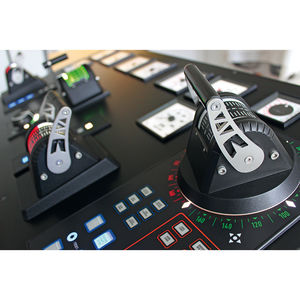

... Individual bridge design for a uniform look & feel on your bridge The NORISYS 4 automation platform not only offers components for remote control and monitoring, but also control and display panels ...
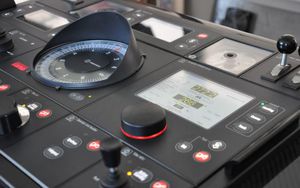

... advanced steering gear control system for customers that require reliability, safety and an outstanding functional range. Its modular system architecture enables standardized and cost-effective ...
Anschuetz
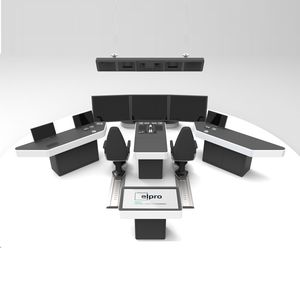

... • Resilience at our core in design and engineering work. Services • Specification in close cooperation with client and systems integrator. • Project management from A to Z. Single point of for clients. • Engineering ...
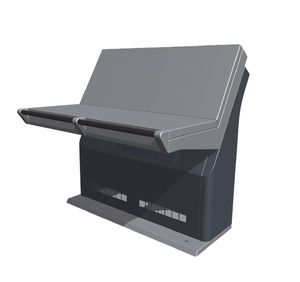

... in order to comply with specific requests. The best of Dutch design has created a unique, versatile and innovative bridge system based on the highest quality materials and manufacturing techniques. ...


... -Master bridge installation there is a common user interface for the following systems: dynamic positioning (DP) and the independent DP joystick, manual propulsion and thruster control, alarm ...


... thermal cameras Machinery control and automation systems Alarm systems Vessel optimization display Integrated Platform Management System (IPMS) Ship stability system DP ...


... STATION Thanks to the INS Voyager Bridge is possible to take the control of all the bridge functions from a single station. It is possible to operate on the navigation ...
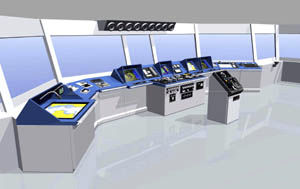

... the psychological pressure on the officer on watch. The IBS (Integrated Bridge System) plays a vital role as a navigational aid. The electronic sea chart performs a central ...
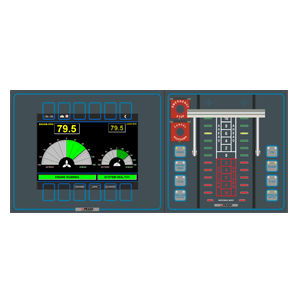

... on the Bridge, the Control Room and on the Local Emergency Stand are easy to operate and to install. The remote control system receives orders from the combined manoeuvring / telegraph lever on the Bridge ...
Praxis Automation Technology
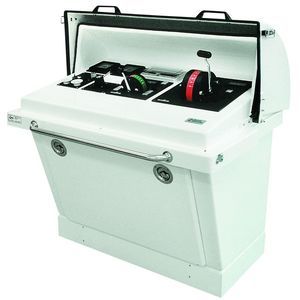

... consoles (Bridge Wing Consoles) for external use. They are made of GRP material which is lightweight and maintenance free compared to metal consoles. It is flexible in design and it is easy to adjust and cut out ...
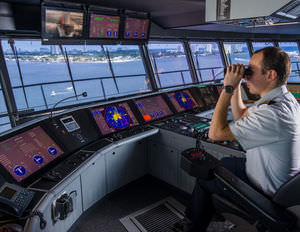

... maintenance. Our Integrated Bridge System design provides ease of integration with all of our navigation product lines and third party equipment thereby providing a total ...
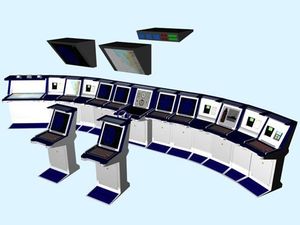

... Navigation System is based on «IBS» concept (Integrated Bridge System) The navigation system will adopt and follow the latest international standards ...
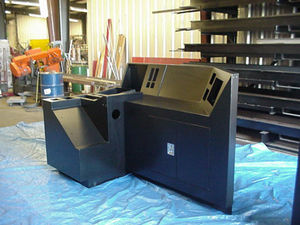

Consoles and Chart Tables can be manufactured from 11 gauge steel or 1/8" aluminum and finished to customer’s specification


... service friendliness. Drawers and hatches are integrated to store and hide various kinds of equipment and charts. The radio Zeeland DMP wheelhouse console structures are built for the integration of navigation ...
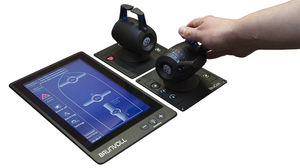

BruCon Control system for all types of propulsion and thruster system configurations Bridge control system for easy visualisation and operation Customized and ...
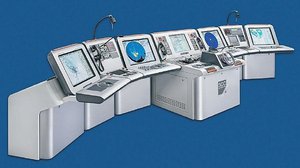
An integrated bridge system (IBS) is one that integrates instruments such as radar, AIS, ECDIS and helm controls.
ApplicationsThese systems allow the watch officer to consult data from any device connected to the system. They are found on tugboats, merchant ships, luxury yachts and many other types of vessel.
TechnologiesThe IBS includes a multi-function display offering access to data from any linked instrument. It is designed so that failure of any integrated component is immediately brought to the attention of the watch officer. The remaining functional components can be operated individually or as a group.
The system usually includes radar/ARPA, AIS, ECDIS, steering controls, VDR, VHF and GMDSS communications, gyrocompass, heel and stabilizer instrumentation, autopilots, speed logs and other devices.
IBS performance standards were defined by the IMO in its 1996 Resolution MSC.64(67).
- Unified monitoring and control
- Requires a familiarization period
Please specify:
Help us improve:
remaining