
- Home page
- buying guide
- jon boat
jon boat
jon boat: A technical guide

4 Criteria to choose your jon boat
Hull material thickness.
Marine-grade aluminum thickness dictates puncture resistance and lifespan during shallow-water commercial operations and heavy equipment transport.
Payload weight capacity.
Accurate displacement calculations ensure safe transport of work crews and specialized technical equipment in diverse inland waterways.
Transom structural reinforcement.
High-yield stress thresholds at the transom are essential for supporting heavy outboard and surface-drive propulsion systems.
Interior deck configuration.
Optimized floor layouts determine the efficiency of cargo loading and the integration of specialized maritime tool storage.
Available technologies and advantages
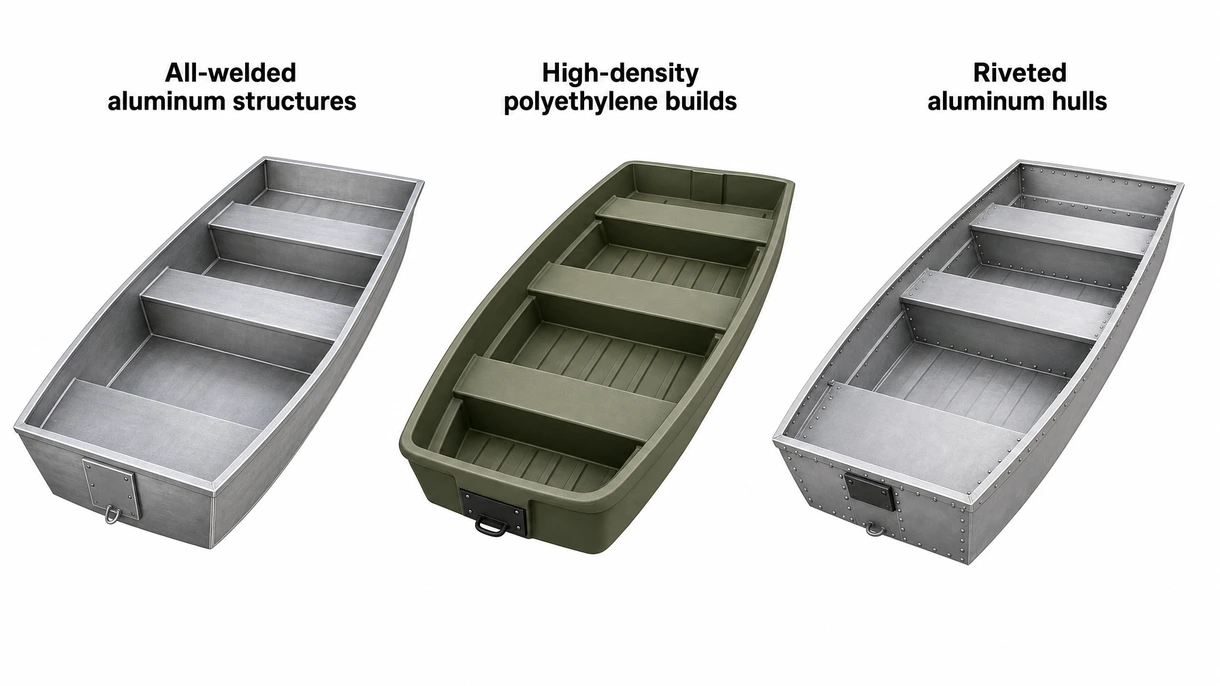
All-welded aluminum structures.
Continuous welding provides superior structural rigidity and leak prevention compared to riveted alternatives, ensuring significantly lower long-term maintenance cycles and higher resale value for professional fleet owners.
High-density polyethylene builds.
High-density polyethylene construction offers extreme impact resistance and chemical immunity, though it presents lower overall structural stiffness compared to professional marine-grade metal hull configurations.
Riveted aluminum hulls.
Riveted designs provide cost-effective fleet procurement for light-duty maritime tasks but require frequent inspections for potential joint integrity loss over operational lifespans.
6 expert tips
Always verify the technical certification to ensure compliance with local building safety standards and long-term durability.
Select marine-grade alloy series to ensure maximum corrosion resistance and structural longevity in brackish environments.
Verify that the hull design includes integrated longitudinal stringers to provide necessary rigidity for heavy commercial equipment transport.
Prioritize flat-bottom profiles for maximum stability during stationary technical work despite the trade-off in rough water handling performance.
Mandate the inclusion of spray-in liner coatings to provide essential slip resistance and noise dampening for professional crews.
Confirm the availability of standardized accessory mounting tracks to allow for rapid reconfiguration of modular onboard technical gear.
Innovations and Trends
Adoption of high-torque electric propulsion reduces operational fuel costs and meets strict European zero-emission inland waterway regulations.
Standardized modular bow mounts now support advanced sonar arrays and heavy-duty winches for diverse hydrographic surveying missions.
New drainage designs utilize gravitational flow to clear water rapidly, significantly improving vessel stability and crew safety.
Strategic shift toward sustainable alloy sourcing helps fleet operators meet environmental corporate governance goals while maintaining structural integrity.
*Prices are pre-tax. They exclude delivery charges and customs duties and do not include additional charges for installation or activation options. Prices are indicative only and may vary by country, with changes to the cost of raw materials and exchange rates.
About NauticExpo
NauticExpo is a marketplace that offers B2B players a complete experience, from product sourcing to purchase. NauticExpo is an entity of VirtualExpo Group.
Are you a buyer?
Are you a supplier?