|
|
|
|
|
|
|
Bio Sludge Treatment System
In the Bio sludge Treatment System all sludge from waste water and food waste is processed. The system is tailor made to secure the interface between liquid and solid sludge before final incineration.
The main target for the bio sludge treatment system is to reduce volume by dewatering, drying and to disinfect. Sludge from waste water and food waste represents a large volume that needs further treatment To align with the environmental requirements for no pollution at sea, the need for a sludge treatment process onboard is obvious.
Dewatering of sludge increases dryness up over 20% reducing the volume 90%. The reject water from the dewatering is treated in the Scanship waste water system.
To increase the dryness further, all dewatered sludge is treated in a drying process. The process increases the dryness up to 60%, making the solids burnable. Dried sludge is stored in the silo separately from the burnable garbage to prevent fire. The drying process increases temperature up to a level where all bacteria will be killed. The end product is free from odour and the risk of contamination has been eliminated.
|
|
The Uson One-way macerator system is designed for hygienic transportation and treatment of food waste in compliance IMO Marpol 73/78 Annex V, U.S. Coast Guard, etc.
Food waste is ground by local macerator(s) in the galley and transported by vacuum to a special holding tank, which is designed for food waste. This makes it possible to run the system when the vessel is operating within an area where discharge is prohibited.
By using this system, ship owners ensure:
Proper hygiene
Lower water consumption
Minimum the risk for blockage of food waste in the piping system
Easy installation
Smaller piping diameter
Flexible pipe routing
In addition, the ground food waste can be de-watered by a sieve and press unit and our marine grease separator takes care of the greasy galley water. The system is suitable for retrofit onboard existing vessels. The system safely handles food waste and is easy to install, with low water consumption, small pipe diameter and flexible pipe routing.
|
|
Vacuum food waste collecting
The food waste system is designed on vacuum conveying technology.
The system allows segregated conveying of the food waste generated onboard. It is completely automatic and designed as entirely closed assemblage.
The processing lines can work independently, collecting the food waste from the designated feeding units or switching all the units to one collecting line due to the cross connection facility.
The water extractor delivers 20% dry solid content (DSC).
Food Waste is thereafter dried and incinerated in the Internal Dryer.
|
|
Food Waste System
Onboard a modern cruise ship a substantial amount of food waste is collected from galleys, pantries and preparation. To align with future requirements, the cruise industry chooses to process food waste onboard.
Scanship has developed an efficient vacuum system for collecting, transporting and further processing of food waste. Transportation by vacuum reduces the need for complicated pipelines and pumps. It is hygienic with minimal odour and does not have any infectious water in circulation between feeding stations and the processing equipment. Vacuum transport ensures safe transport through the pipes to the central processing system. Vacuum transportation also contributes to the homogenizing of the food waste before further processing.
The Scanship Food Waste System meets requirements of the U.S. Public Health and U.S. Coast Guard regulations as well as the European HACCP standards.
|
|
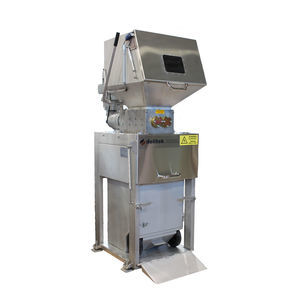
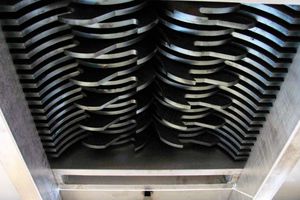
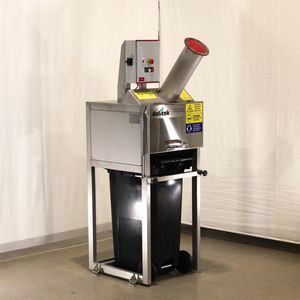
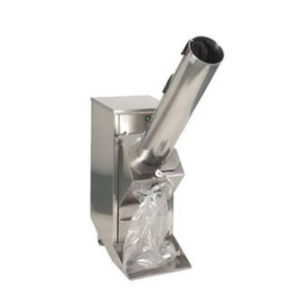
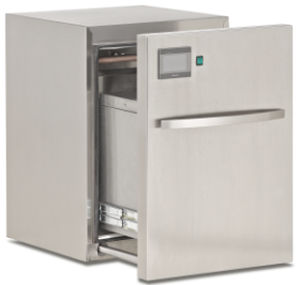
The U-80 glass crusher is an easy solution for treatment of large volumes of glass. The bottles are manually fed through the feed pipe and the glass pieces are collected in a standard 80 liter wheelie bin.
The crusher produces pieces of about 40 mm diameter which makes them acceptable for recycling. Too small pieces make it impossible to detect porcelain, which destroys the glass melt, and is therefore not accepted for recycling. The volume reduction is approximately 80%. No glass smoke is produced when crushing the glass bottles. The machine is fitted with a level indicator that stops the crusher when the bin is full to prevent overfilling.
|
|
Incinerator (model no.) 2400 LP 2400 SL XL WS P
Combustion Capacity (kW) 2325 2325
Combustion Capacity (kcal/h) 2,000,000 2,000,000
Combustion Capacity - Solid waste
IMO spec. (kg/h) - 230
IMO spec. (l/charge) - -
Combustion Capacity - Sludge oil
IMO spec. (l/h)
(at 20% water content) 263 263
Max. l/h
(at approx. 50% water content) 400 400
Outlet from incinerator (mm) ø 550 ø 550
Weight approx. (kg) 11,000 11,200
|
|
Incinerator (model no.) 600 S WS 600 SL P 600 SL WS P
Combustion Capacity (kW) 581 581 581
Combustion Capacity (kcal/h) 500,000 500,000 500,000
Combustion Capacity - Solid waste
IMO spec. (kg/h) 100 - 100
IMO spec. (l/charge) - 250 -
Combustion Capacity - Sludge oil
IMO spec. (l/h)
(at 20% water content) - 66 66
Max. l/h
(at approx. 50% water content) - 100 100
Weight approx. (kg) 4,850 4,600 4,850
|
|
Incinerator (model no.) 800 S WS 800 SL P 800 SL WS P
Combustion Capacity (kW) 814 814 814
Combustion Capacity (kcal/h) 700,000 700,000 700,000
Combustion Capacity - Solid waste
IMO spec. (kg/h) 100 - 100
IMO spec. (l/charge) - 350 -
Combustion Capacity - Sludge oil
IMO spec. (l/h)
(at 20% water content) - 95 95
Max. l/h
(at approx. 50% water content) - 140 140
Weight approx. (kg) 5,800 5,500 5,800
|
|
Incinerator (model no.) 200 S WS 200 SL 200 SL WS
Combustion Capacity (kW) 209 209 209
Combustion Capacity (kcal/h) 180,000 180,000 180,000
Combustion Capacity - Solid waste 40 - 40
IMO spec. (kg/h)
IMO spec. (l/charge) - 150 -
Combustion Capacity - Sludge oil
IMO spec. (l/h) 24 24
(at 20% water content)
Max. l/h
(at approx. 50% water content) 38 38
Weight approx. (kg) 3,175 3,050 3,175
|
|
Incinerator (model no.) 1200 S WS 1200 SL P 1200 SL WS P
Combustion Capacity (kW) 1163 1163 1163
Combustion Capacity (kcal/h) 1,000,000 1,000,000 1,000,000
Combustion Capacity - Solid waste
IMO spec. (kg/h) 230 - 230
IMO spec. (l/charge) - 500 -
Combustion Capacity - Sludge oil
IMO spec. (l/h)
(at 20% water content) - 135 135
Max. l/h
(at approx. 50% water content) - 200 200
Outlet from incinerator (mm) ø 406 ø 406 ø 406
Weight approx. (kg) 6,100 5,700 6,100
|
|
Incinerator (model no.) 1500 LP 1500 SL XL WS P
Combustion Capacity (kW) 1500 1500
Combustion Capacity (kcal/h) 1,290,000 1,290,000
Combustion Capacity - Solid waste
IMO spec. (kg/h) - 230
IMO spec. (l/charge) - -
Combustion Capacity - Sludge oil
IMO spec. (l/h)
(at 20% water content) 170 170
Max. l/h
(at approx. 50% water content) 258 258
Outlet from incinerator (mm) ø 456 ø 456
Weight approx. (kg) 8,000 8,200
|
|
|
|
|
|
|
Solid wastes are fed into the incinerator through the garbage door and incinerator is then switched on.
For the combustion of pumpable waste, the homogenizer (L) positioned on the sludge service tank, has to be started up, after the neccessary water setting and drainge. It's now necessary to switch the sludge pump (H) so as to feed the sludge into the incinerator.
Heated by an electric heater (Q) the sludge is fed to the main burners (B) and sprayed into the furnace. The pilot burner (A) fed by the Diesel-oil pump (I) ignites or vaporizes the sludge depending upon its condition.
The air fan (C) is installed to supply air for combustion, aswell as for cooling and dilution, to ensure a flue gas temperature below 350°C.
The atomized air for the main burners (B), comes from the air pressure reducing device (D) fed by the ships compressed air service piping, or alternatively by an air blower. The monitoring and control devices installed in the control panel, modulate the incinerator action on the thermal load and carry out its automatic and operation.
|
|
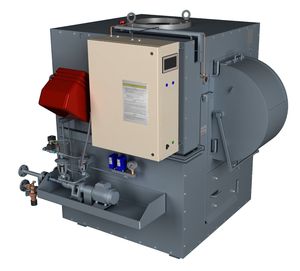
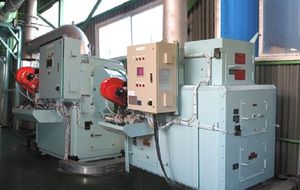
The sturdy, compact design and high performance make it an obvious first choice for solving the waste problems on medium size vessels.
The incinerator consist of a combustion chamber with burner unit, sludge burning equipment and electric control panel, all assembled in one complete unit resting on four (4) feet or pads to be welded or bolted to the deck or platform. A flue gas damper and cooling fan are delivered as separate units to be installed in the flue gas duct or funnel. The starter for the flue gas/cooling fan is located in the incinerator control panel.
|
|
One of the most effective marine incinerators on the market today. Available with manual or automatic feeding of solid waste and full automatic sludge burning.
The incinerator consist of a combustion chamber with burner unit, sludge burning equipment and electric control panel, all assembled in one complete unit resting on six (6) feet or pads to be welded or bolted to the deck or platform. A flue gas damper and cooling fan are delivered as separate units to be installed in the flue gas duct or funnel. The starter for the flue gas/cooling fan is located in the incinerator control panel.
|
|
The sturdy, compact design and high performance make it an obvious first choice for solving the solid waste problems on medium size vessels.
The incinerator consist of a combustion chamber with burner unit and electric control panel, all assembled in one complete unit resting on four (4) feet or pads to be welded or bolted to the deck or platform. A flue gas damper and cooling fan are delivered as separate units to be installed in the flue gas duct or funnel. The starter for the flue gas/cooling fan is located in the incinerator control panel.
|
|
|
With sluice for continuous feeding of solid waste. The sturdy, compact design and high performance make it an obvious first choice for solving the solid waste problems on medium size vessels.
|
|
Probably the most compact marine incinerator - relative to capacity – on the
market! Batch loading of solid waste, and fully automatic sludge burning. With
NOx reducing bilge water injection as standard.
The incinerator consist of a combustion chamber with burner unit, sludge burning equipment, bildge water injection unit, primary air fan and electric control panel, all assembled in one complete unit resting on six (6) feet or pads to be welded or bolted to the deck or platform. A frequency converter and cooling fan are delivered as separate units to be installed in the flue gas duct or funnel. The starter for the flue gas/cooling fan is located in the incinerator control panel.
|
|
The very high capacity marine incinerator developed for ships with large heavy fuel propulsion plants. Badge loading of solid waste, and fully automatic sludge burning.
The incinerator consist of a combustion chamber with two burner units, sludge burning equipment, primary air fan and electric control panel, all assembled in one complete unit resting on eight (8) feet or pads to be welded or bolted to the deck or platform. A flue gas damper and flue gas cooling fan are delivered as separate units to be installed in the flue gas duct or funnel. The starter for the flue gas/cooling fan is located in the incinerator control panel.
|
|
The smallest in the range of the well-known TeamTec incinerators. The sturdy,
compact design and high performance make it an obvious first choice for solving the waste problems on small and medium size vessels.
The incinerator consist of a combustion chamber with burner unit and electric control panel, all assembled in one complete unit resting on four (4) feet or pads to be welded or bolted to the deck or platform. A flue gas damper and cooling fan are delivered as separate units to be installed in the flue gas duct or funnel. The starter for the flue gas/cooling fan is located in the incinerator control panel.
|
|
Retrofit Internal Dryer
The internal dryer can be installed in all existing incinerators.
Less Cost
With the internal dryer you reduce costs for installation and operation.
Less Energy
Food waste and bio sludge with water content up to 80 % are fed continuously into the incinerator where they are dried and burned without adding any extra energy.
The incinerator is even capable of operating with a considerably higher power output due to water evaporation.
Less Space
Compact solutions are essential onboard ships. Especially in terms of wet waste drying equipment for bio sludge. A standard dryer system would occupy an already limited space. For our dryer you will find space on any ship.
|
|
Cost-effective removal of water from oily sludge
Whether you pump your oily sludge ashore or burn it, it's preferable to reduce the water content first. Oily sludge can contain as much as 80% water. With a Marinfloc Sludge Dewatering Unit, the amount of residual water in the sludge is reduced to a minimum. This makes it possible to burn the sludge or pump it ashore at a lower cost.
|
|
|
|
|
|
|
Waste Incinerator System
The incinerator is designed to burn mixed solid waste, sludge oil and dewatered wet waste according to the IMO standard.
From a sorting table the waste is manually fed into a heavy-duty shredder.
The shredded burnable waste is fed by gravity into the dry waste silo. The silo is equipped with level sensor, heat detector and connection for fire fighting.
By gravity the waste falls into the incinerator's feeding chamber with hydraulically driven upper and lower sliding gates.
In the incinerator the burning of waste is done in two steps. In the primary chamber decomposition is achieved by partial pyrolysis. The complete breakdown of gases and residual components takes place in the secondary chamber. The temperature in the incinerator is approx. 850 °C to ensure a complete destruction of all organic materials and consequently the flue gas is odourless.
The incinerator is equipped with a water injection system for increased waste burning capacity and reduced oil consumption.
For automatic control of opacity and temperature of flue gases, a smoke density/temperature unit is installed between the flue gas/air mixing battery and the flue gas fan. The unit controls the supply of combustion air and the secondary burner. The sensors are automatically cleaned using compressed air.
The system is designed for continuous operation with automatic removal of ash from the ash bed. A screw conveyor empties the ash into an interchangeable ash container. The container is transported by lift to the garbage room, where it is stored for later ashore disposal.
|
|
The incinerators in our program are very easy to operate and require a minimum of maintenance.
The annex V of MARPOL 73 regulates the discharge of garbage. It is much easier to comply with the regulations if you install an incinerator that really works and, even more important, that is very easy to operate and maintain. The incinerator need not be a headache for the crew, the automatic processes of our marine incinerators make them ideal to work without excessive care and with reduced maintenance.
With our incinerator you can dispose of one or more of the following
sludge (heavy fuel oil installation)
waste oil
lubricants
solid waste like cardboard, plastics, paper, wood, rubber, cloth, oily rags
food waste
sewage sludge
hospital waste (on hospital ships)
The incinerators are type approved according
European Marine Equipment Directive 96/98/EC, as amended by Directive 2002/75/EC
Marpol 73/78 annex V, Regulation 16 (2) (a), as amended
IMO resolution MEPC.76/40
|
|
|
|
|
|
|
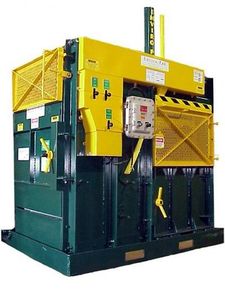
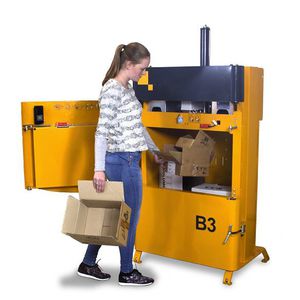
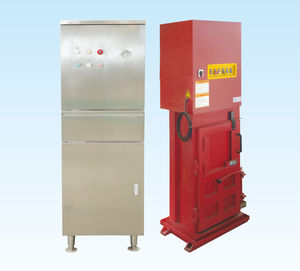
Compactors are used to reduce the volume of waste stored on board. Afterwards it can be properly disposed of in port.
For easy handling and sorting we have in the program the:
Uson Multi Chamber Compactor, UMCC
This unique unit makes it possible to perform general waste treatment and basic, cost efficient source sorting in one single unit. The UMCC has different waste chambers which may be used for various purposes, such as compaction and baling of plastic film or cardboard boxes or compaction of plastic bottles, fruit crates, mixed dry waste and cans. The press power unit is moved side-wards with a "dead man's hand" grip and a side motion motor, thus securing safe and comfortable operation.
Flexibility with everything from 2 to 8 chambers; also adjustable after delivery.
Three chamber appearances: for sack compaction, baling and tin compaction.
Standard unit with four chambers for: sack compaction, tin compaction and 2 x baling.
Easily assembled; easily serviced from front.
Hammer-finish enamelled strong steel frame construction.
5 ton press force reduces a volume of 700 litres to 125 litres.
Baling at full press force.
Variable bale size.
Signal for ready sack/bale.
Front door locked during compaction.
|
|
|
|
|
|
|
Top Performance Under Harsh Conditions
The Red Fox Environmental Cajun Crusher was specifically engineered to perform under the rigorous demands placed on equipment operating in the marine industry. High performance levels and product dependability demanded of all Red Fox Environmental products are built into every model. The Red Fox Environmental Cajun Crusher line is designed to deliver trouble-free service, with continuous operation and normal routine maintenance. With an estimated life expectancy of 15 years, the Red Fox Cajun Crusher will also deliver true economy and value.
Simple to Operate
You won't have to send your personnel to school to learn to operate the Red Fox Cajun Crusher. The controls are easily accessible in a closeable panel, and afford the operator total control from one station.
Safety Is Extremely Important
Operator safety was given a high priority in the development of the Red Fox Cajun Crusher product line. Structurally, all models of the Red Fox Cajun Crusher are fabricated to withstand heavy loads and constant use without failure. Wiring harnesses and all electrical, pneumatic and hydraulic components are routed to afford maximum safety to personnel as well as provide efficient performance. Controls are housed in explosion-proof protectors where needed. The vast majority of our units are air operated using techniques that deliver foolproof operation.
Specifications
The Red Fox Cajun Crusher is available in (4) models: 12 ft³, 30 ft³, 40 ft³ and 50 ft³. All models are offered with the options of electric over hydraulic or pneumatic over hydraulic and have the capability of crushing 55 gallon steel drums.
|
|
Recycling units and systems
Our recycling systems are designed to recycle through compacting aluminium cans, paper, plastics and crushed glass. The volume is thus reduced and the materials are easily stored until brought ashore for final recycling. Scanship provides safe, efficient systems for garbage treatment.
|
|
|
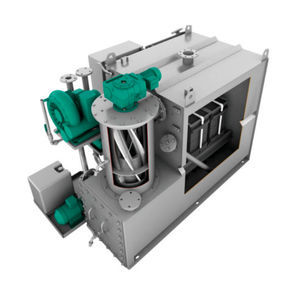
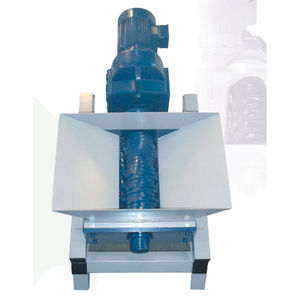
The Börger Multicrusher - an effective, widely applicable twin shaft macerating maschine for solids and debris laden fluids.
|
|
|
It especially macerates and conditions stringent material in homogenous sludge - the Börger Multichopper.
|
|
|
|