|
|
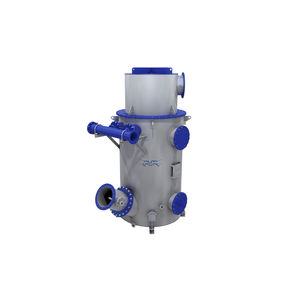
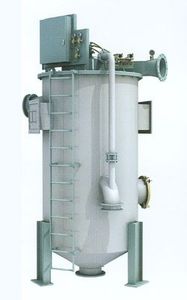
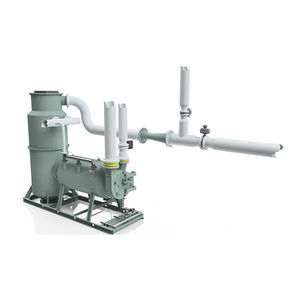
This system, which is specifically designed for the Flue gas from oil-fired boilers, is primarily used on crude oil tankers. The flue gas is extracted from existing boilers by fans and is drawn through a scrubber where it is cooled and washed before being delivered to the cargo tanks.
With success, Aalborg Industries Inert Gas Systems introduced in 2004 a new Flue gas System which offers compact design in combination with improved particle removal.
Years of experience (since 1970) and customer feedback resulted in this new design, offering advantages to both the shipyard (ease of installation) and ship owner (operational features).
Fluegas systems are typically used on Crude oil tankers and Product tankers.
|
|
|
The Moss Flue Gas System is tailor made for use on board Crude Oil Carriers. The design is based on experience from hundreds of installations.
|
|
For gas- and chemical transportation the inert gas needs to be of high purity. For many applications, oxygen levels of 0.5% or even 0.1% are required, in combination with a water dew-point of about -45 °C and sometimes lower
(-65 °C). Also here, the burner is the heart of the system as the inert gas needs to be absolutely soot free in the first place. This is achieved with the Ultramizing® Combustion system. When the gas leaves the generator, it has the right composition, but it is saturated with 100% water and has to be dried. The drying process takes place in two steps. In the first step of the refrigerant cooler, the gas temperature is lowered to 5 °C which results in condensation of a great quantity of water. In the second stage the inert gas is dehumidified further in a double vessel type drying-unit using activated alumina or adsorbent. The whole process operates under a pressure of about 0.3 bar(g).
|
|
For lower capacities and for applications where high delivery pressure is required, like for instance on LPG carriers, the inert gas is compressed by a rotary screw type compressor. The compressor is working at the same time as a dryer by condensing most of the water in the after cooler. However, for low dew-point an absorption dryer will be required where the inert gas is dried to the final dew-point.
Combustion type nitrogen generators:
Nitrogen can be generated by the same high pressure type inert gas generator by adding a CO2 stripper. This stripper removes the CO2 in the inert gas (originally N2 + CO2) by in a double vessel type adsorption system by means of molecular sieves. This type of nitrogen generator is specially used in cases of high capacities and high purity.
|
|
The Combinert is actually an Inert Gas Generator and Fluegas system in one. It is compact, versatile in its use and has very good operational qualities.
It can operate in two modes:
Inert gas generator:
In the inert gas generator mode, inert gas is produced by combustion of fuel and oil with air. Operating principle is the same as described under Inert Gas Generator.
Boiler flue gas system:
In the boiler fuel gas mode, the Inert Gas Generator is not being used, the Fluegas enters the Combinert through the Venturi scrubber and is further treated in the scrubber.
|
|
|
The Inert Gas is produced by the combustion of fuel oil with air in a water-cooled combustion chamber, in which controlled, complete combustion takes place. The Ultramizing® Combustion system assures soot-free combustion at all times, also at part load conditions. The chamber is indirectly cooled by seawater, whereas after-cooling and sulphur oxide washing occur directly in a specially developed spray and cooling system in a second stage. The clean combustion products, that is Inert Gas with a typical oxygen content of 2% leave the generator at a temperature a few degrees C above that of seawater. The condensed water vapour is discharged together with the cooling water. The combustion process is monitored and controlled by the oxygen analyzer.
|
|
|
The Moss Inert Gas Generator Systems for use onboard Gas Carriers, Product & Chemical Carriers, FPSOs and FSOs also used as a Topping Up Generator on Crude Oil Carriers.
|
|
Features and benefits
• On-site nitrogen generator
• Based on Pressure Swing Adsorption (PSA) technology
• Fully automated, plug-and-play
• As standard calibrated to produce min. 500.0 (95.0%) Nm3/hour
|
|
Features and benefits
• On-site nitrogen generator
• Based on Pressure Swing Adsorption (PSA) technology
• Fully automated, plug-and-play
• As standard calibrated to produce 300.0 (95.0%) Nm3/hour
|
|
Features and benefits
• On-site nitrogen generator
• Based on Pressure Swing Adsorption (PSA) technology
• Fully automated, plug-and-play
• As standard calibrated to produce 1292.0 (95.0%) Nm3/hour
|
|
Features and benefits
• On-site nitrogen generator
• Based on Pressure Swing Adsorption (PSA) technology
• Fully automated, plug-and-play
• As standard calibrated to produce 200.0 (95.0%) Nm3/hour
|
|
|
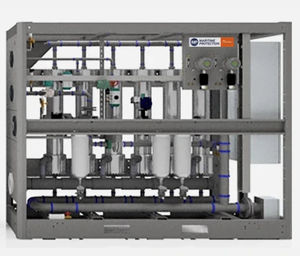
The Moss Nitrogen Generator System is a compact and high efficient system based on air separation by use of hollow fibre membrane modules.The resulting nitrogen is dry and depleted of carbon dioxides.
|
|
Product philosophy
The Verhaar Omega nitrogen generators are designed by using
innovative solutions for known and existing issues with other
systems available on the market.
Listening to the specifi c requests from shipyards, ship-owners, classi-
fi cation bureaus and plant operators, our systems are designed, manu-
factured and delivered based upon the following product features.
%u2022 Complete system design and supply
%u2022 High nitrogen capacity with small unit dimensions
%u2022 Constant and stable production of nitrogen
%u2022 Easy and minimum maintenance
%u2022 Self maintaining and intelligent system control
%u2022 Clear and simple system operation
|
|
|
Generators with a capacity of normally 500 m3/h are applied on Crude Oil Tankers, both for topping-up purposes during the voyage and for inerting slop and ballast tanks. The Smit topping-up gas generator fits with any Flue Gas System on board new and existing vessels.
|
|
The inert gas is produced by the combustion of fuel oil with air (via the Ultramizing® Combustion system) in a water-cooled combustion chamber, in which controlled, complete combustion takes place.
The portable inert gas generator has a capacity of 2,000 m3/h and is made in a very compact design that is easy to operate. The container can easily be airlifted without modification or disassembly. Typical applications of the portable solution are temporary use while the main inert gas generator on a tanker is out of order and on salvage jobs.
|
|
| ... products without information |
| |
|
|