


{{product.productLabel}} {{product.model}}
{{#if product.featureValues}}{{product.productPrice.formattedPrice}} {{#if product.productPrice.priceType === "PRICE_RANGE" }} - {{product.productPrice.formattedPriceMax}} {{/if}}
{{#each product.specData:i}}
{{name}}: {{value}}
{{#i!=(product.specData.length-1)}}
{{/end}}
{{/each}}
{{{product.idpText}}}
{{product.productLabel}} {{product.model}}
{{#if product.featureValues}}{{product.productPrice.formattedPrice}} {{#if product.productPrice.priceType === "PRICE_RANGE" }} - {{product.productPrice.formattedPriceMax}} {{/if}}
{{#each product.specData:i}}
{{name}}: {{value}}
{{#i!=(product.specData.length-1)}}
{{/end}}
{{/each}}
{{{product.idpText}}}
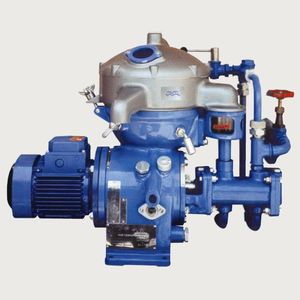

... Purification or clarification of mineral oils used in marine installations and power stations (fuel and lubricating oils). Separation takes place in a solids-retaining bowl that can be arranged for either clarification or purification. In both cases, ...
Alfa Laval Mid Europe
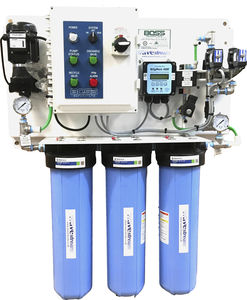

... MEPC 107/49 certified bilge filter system giving effective control and prevention of oily bilge water discharge using Wavestream System 3 filters. IMO certified Oil in Water Monitor with 18 months data logging, 3 models available. MED Approvals.. US ...
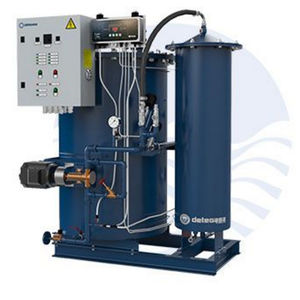

... The main purpose of the oily water separator is to separate the hydrocarbons from oily water coming from the bilge of a ship and deliver a cleaner effluent that can be discharged overboard according to IMO MEPC 107(49) regulation. The OWSAN series ...
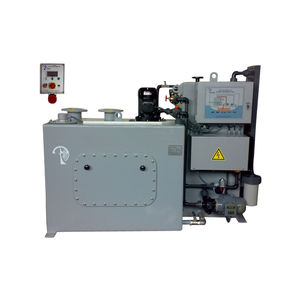

... Marine Sewage Treatment approved for both marine/land. Any combination of fresh & salt water, WC/Showers, toilets, laundry, galley.The Marine Sewage Treatment Plant certified in compliance with :USCG under 33 CFR Part 159IMO – Resolution MEPC (VI)IMO ...
Mavi Deniz
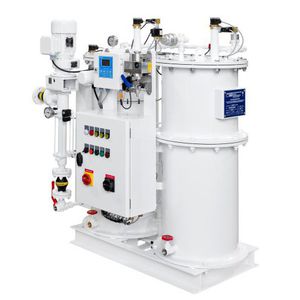

... Type Approval in accordance with IMO Resolution MEPC.107 (49) In compliance with LDNV TAP 771.60, Clean Design Optional with type approved FSU® By-pass Function Capacity from 150 l/h up to 10.000 l/h Jet-wash oil drainage Compact design and easy ...


Yachtgarage
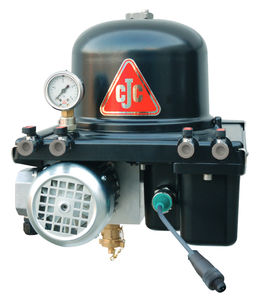

... PTU 15/12 is a compact filer separator for maintaining clean oil and dry oil, such as: diesel oils hydraulic oils gear oils food grade oils with a specific weight lower than that of water. The filter is a 3-micron absolute filter with a high ...
C.C. Jensen


... Type Approval in accordance with IMO Resolution MEPC.107 (49) In compliance with LDNV TAP 771.60, Clean Design Optional with type approved FSU® By-pass Function Capacity from 150 l/h up to 10.000 l/h Jet-wash oil drainage Compact design and easy ...
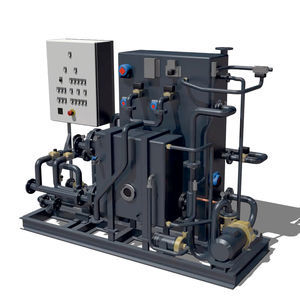

... Produces crystal clear water (15/5ppm). Instead of trying to remove pollutants from the water, the OWE effectively removes the water from the pollutants. Our simple solution process the water by two successives stages: Stage 1: Coalescing + Settling Of ...
DAMSIA
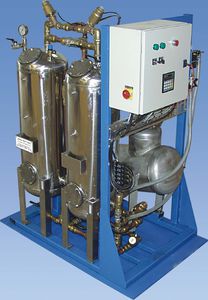

The JOWA 3SEP OWS is a dual stage oily bilge water separation system utilizing differential specific gravity, coalescence plates and filtration to separate and remove free and emulsified oil. The system is designed as a skid assembly with all connection ...
JOWA USA
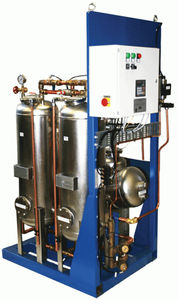

The 3SEP OWS is a dual stage oily bilge water separation system utilizing differential specific gravity, coalescence plates and filtration to separate and remove free and emulsified oil. The unit is available in five different capacities; 0.5 m3/h, 1.0 ...
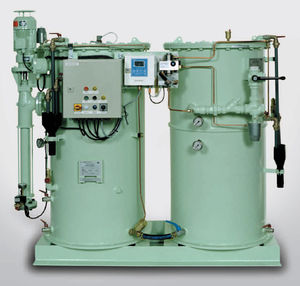

... The Turbulo oil water separator has a two-stage design: First Stage - A pressure system with oleophilic coalescer inserts (large surface area, corrosion-resistant) operates via a gravitational principle. Oily water is passed through the separator via ...
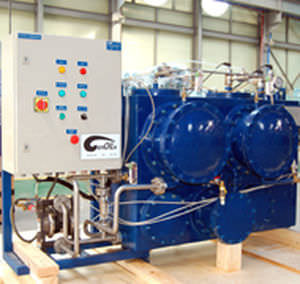

OWS is an equipment to separate oil and water mixtures (Bilge Water) into their separate components before discharging from the ship.
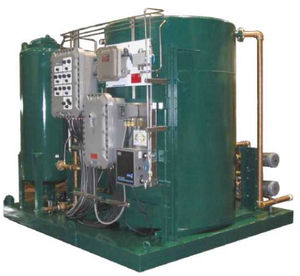

... Approved as per IMO Regulations. Easy and quick installation. New automatic operation. Integrated pump, pipes and base frame. Sizes for all ships. Easy maintenance, with low operation costs. Oil in Water Discharge with TPH < 15 ppm MEPC ...
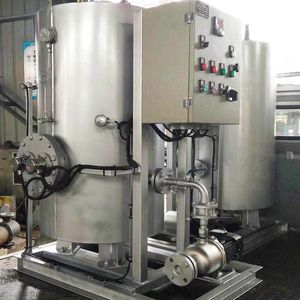

... Fountom is providing the oily water separators with the stablest technology that fully follows latest standards -MEPC 107(49) and widely installed on all kinds of ships. Fountom oily water separator can effectively dispose the fluids in bilge water ...
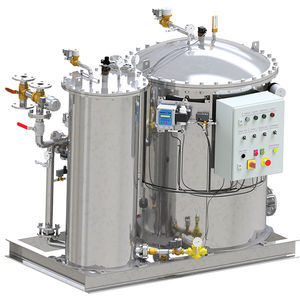

... The New Generation of Oil Water Separator certified for 5ppm POSEIDON FIT Bilge Oil Water Separator consists of two stages; the coalescer and the emulsion breaking unit. The coalescer works on a continuous mode, by passing the second stage, and only ...
Environmental Protection Engineering S.A.