


{{product.productLabel}} {{product.model}}
{{#if product.featureValues}}{{product.productPrice.formattedPrice}} {{#if product.productPrice.priceType === "PRICE_RANGE" }} - {{product.productPrice.formattedPriceMax}} {{/if}}
{{#each product.specData:i}}
{{name}}: {{value}}
{{#i!=(product.specData.length-1)}}
{{/end}}
{{/each}}
{{{product.idpText}}}
{{product.productLabel}} {{product.model}}
{{#if product.featureValues}}{{product.productPrice.formattedPrice}} {{#if product.productPrice.priceType === "PRICE_RANGE" }} - {{product.productPrice.formattedPriceMax}} {{/if}}
{{#each product.specData:i}}
{{name}}: {{value}}
{{#i!=(product.specData.length-1)}}
{{/end}}
{{/each}}
{{{product.idpText}}}
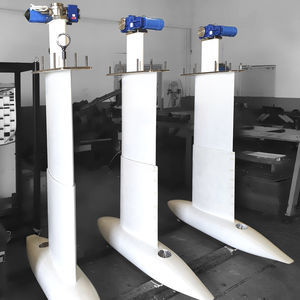

... The Keel Servant will exhibit at METS TRADE Amsterdam 2022, on the 15th, 16th, 17th of November. It will be possible to see the models and the videos of some realizations and meet us for projects and proposals. The adoption of a lifting keel, ...
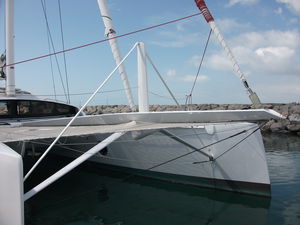


... Description CKM(Canting Keel Manager) is designed for monohulls with a canting and/or retractable keel, operated by an hydraulic or an electric system. CKM... handles the keel safely, secures the vessel in case of capsizing or loss of the keel, manages ...


... The “classic” APM product, 30 years and hundreds of lifting keels of all size and characteristics sailing around the world. Engineered and designed to suit the required naval architect specifications, adapted to the vessels specific requirements, from ...
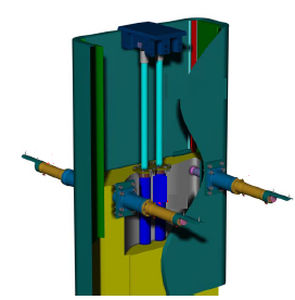

... The possibility of lifting the keel dramatically improves the boat performance while allowing an easy entry in shallow water harbours. Our special double acting cylinders for the keel lifting have both hydraulic connections on the piston rod terminal, ...
Cariboni


... With over 25 years design and build experience, Paul Tilley can supply all of your inflatable RIB Tube or RIB Collar requirements. Our RIB Tubes are built to the highest specification using premium quality ORCA Hypalon Fabric. Tubes are designed and built ...
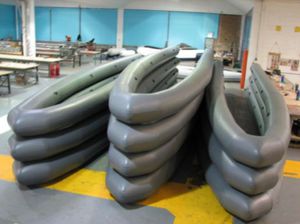

RIB Collars (also known as RIB Tubes) are the inflatable section of a Rigid Hull Inflatable. Henshaw Inflatables are the leading manufacturers of RIB collars and supply both UK and Overseas RIB Builders.All our collars are manufactured from the highest ...