


{{product.productLabel}} {{product.model}}
{{#if product.featureValues}}{{product.productPrice.formattedPrice}} {{#if product.productPrice.priceType === "PRICE_RANGE" }} - {{product.productPrice.formattedPriceMax}} {{/if}}
{{#each product.specData:i}}
{{name}}: {{value}}
{{#i!=(product.specData.length-1)}}
{{/end}}
{{/each}}
{{{product.idpText}}}
{{product.productLabel}} {{product.model}}
{{#if product.featureValues}}{{product.productPrice.formattedPrice}} {{#if product.productPrice.priceType === "PRICE_RANGE" }} - {{product.productPrice.formattedPriceMax}} {{/if}}
{{#each product.specData:i}}
{{name}}: {{value}}
{{#i!=(product.specData.length-1)}}
{{/end}}
{{/each}}
{{{product.idpText}}}


... Rotating Oiltight Hatch Cover for Ships is usually used to oil tankers. It's oil tightness is excellent. There are two shapes of this oiltight hatch cover: type A is round, and type B ...
Zhongyuan Ship Machinery Manufacture (Group) Co.,

... International Convention on Load Lines 1966 (LLC66). The possibility for application in position 1 and position 2. The coaming and cover may have square or rounded corners. Main Technical Specification: Standard: ISO 5778-1998 Material: ...
Zhongyuan Ship Machinery Manufacture (Group) Co.,

... CB/T 3842-2000 type B quick acting small hatch cover is square type watertight hatches. It is designed for hydraulic pressure 0.2MPa. Higher pressure can be designed case by case subject to class approval. The standard ...
Zhongyuan Ship Machinery Manufacture (Group) Co.,
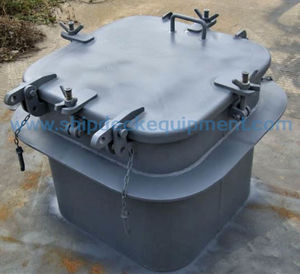
... CB/T 3728-2011 type A weathertight small steel hatch cover is fitted with butterfly nut and is suitable for applying a torque convenient for tightness, by only one man without the help of any tools. For bigger size hatches, ...
Zhongyuan Ship Machinery Manufacture (Group) Co.,
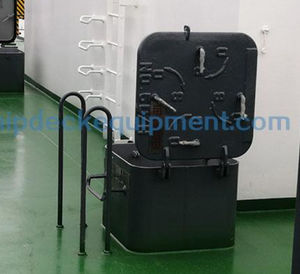
... Type B weathertight hatch cover is can be opened from both sides. It is made of steel and suitable for various vessels. It is produced according to the latest standard of CB/T3728. It has 4 dogs, 6 dogs and 8 dogs type. ...
Zhongyuan Ship Machinery Manufacture (Group) Co.,

... type BC square semi raised multi bolts hatch cover is a kind of watertight and oiltight manhole. It meets the latest standard of CB/T4392. It is made of steel with stainless bolt and nut. We also produce whole cover ...
Zhongyuan Ship Machinery Manufacture (Group) Co.,

... CB/T 3728 type F small steel hatch cover is none weathertight. It is normally fitted on the deck above position 1 and 2, which required by Loadline Rule. It is fitted with thinner rubber packing which can pass water pouring ...
Zhongyuan Ship Machinery Manufacture (Group) Co.,
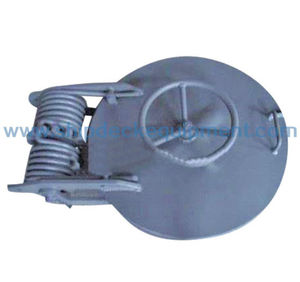
... CB/T 3842 type A quick acting watertight small hatch cover is round type. It is designed to hold the hydraulic pressure 0.2Mpa.It can be opened and closed quickly with a handwheel on both sides. It is fitted with spring ...
Zhongyuan Ship Machinery Manufacture (Group) Co.,
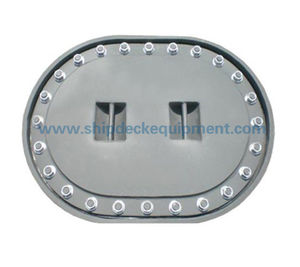
... JIS F 2304 Type C is sunk manhole hatch cover. It is oval shape with multi bolts. Main material is mild steel, bolt and nut has alternative choice for stainless steel, bronze, brass. Our manhole ring is cut as whole piece ...
Zhongyuan Ship Machinery Manufacture (Group) Co.,
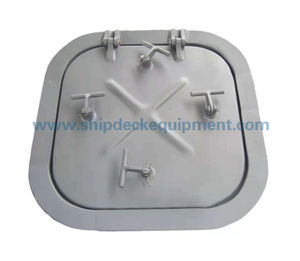
... 3728 type D weathertight small hatch cover with dogs can be made of mild stee, stainless steel or aluminium material. It has 4, 6, 8 dogs design with different opening size. It is flush type and welded on the deck. This ...
Zhongyuan Ship Machinery Manufacture (Group) Co.,


... MADE WITH PROFILES OF OUR DESIGN IN AISI 316L STAINLESS STEEL AND HEAT OR CHEMICAL-TEMPERED GLASS, LAMINATED IF REQUIRED. EQUIPPED WITH TWO INTERNAL LOCKING HANDLES AND STAINLESS STEEL GAS PISTON TO ASSIST OPENING AND HOLDING IN OPEN POSITION. DIMENSIONS ...
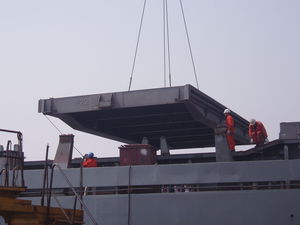

... ship's second-hand value. Hatch cover steel structure For stable and smooth operation of the hatch covers on board, the panels should be stiff. However, to maintain weathertightness ...
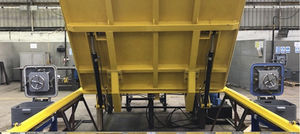

Hatches designed and manufactured to clients required clear opening and load. Hatches gastight and weathertight tested. Operated from two hydraulic cylinders connected to HPU system. All hatches are DNV certified and can be fitted with insulation from ...
MML Marine Ltd

Hatches designed and manufactured to clients required clear opening and load. Hatches gastight and weathertight tested. Operated from 2-4 lifting points for crane operation. All hatches are DNV certified and can be fitted with insulation from thermal ...
MML Marine Ltd
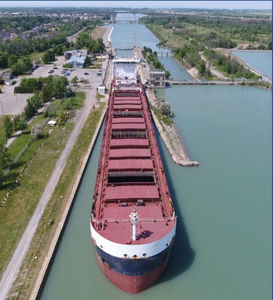


A hatch cover is used to close off a ship's cargo hatches. NauticExpo offers sliding, multi-folding, piggyback and other types.
ApplicationsThese covers protect hold cargo from inclement weather. They also allow cargo to be stowed on deck, as on container ships.
TechnologiesEach of the many different types of hatch cover functions in its own way. Multi-folding covers fold back to give access to the hatch and are operated by hydraulic cylinders. Sliding hatch covers are common on bulk carriers, opening and closing laterally. A hydraulic mechanism lifts the piggyback hatch cover and places it on top of the hatch cover just fore or aft. Lift-on/lift-off hatch covers require a crane to move them.
How to chooseChoice will depend on ship and cargo type. With the exception of the lift-on/lift-off variety, all hatch covers operate via a hydraulic system requiring regular maintenance.
the best suppliers