|
|
The On Board Interface (C3-Obi)
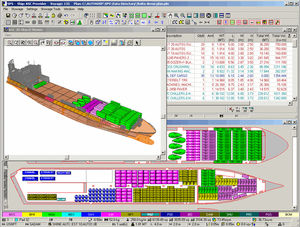
The Capstan3-OnBoard-Interface is specialized for on board usage. As a sister of Capstan3, it provides all of its key features, tailored for easy handling in day-to-day on board usage.
• all calculations including visibility line and lashing forces
• various interfaces for online tank updates
• many reports for various aspects, including reefer monitoring lists
• available for Windows and Linux
|
|
|
|
|
|
|
Capstan3 - The Planners Best Friend
With Capstan3 and its internal database you have all information in one place to manage a whole voyage. Planning ahead for all ports of the voyage is an easy task, as Capstan3 always considers a voyage as a whole and provides fast switching among the different situations. Thus you can easily review the expected condition of your ship at any point of the voyage, or even compare arrival and departure conditions side by side.
Your tools to achieve optimal voyage planning include
- continuous validation of stability, strength and all other parameters
- for easy data exchange, a great number of file formats and EDI messages are supported for import and export, including BAPLIE, MOVINS, IFTDGN, TANSTA and a couple of other formats. In case some special format is requested, we offer quick extensions at competitive rates.
- Automatic check of dangerous goods segregation according to IMDG Code.
- The cranesplit visualization gives valuable feedback on expected operating times in ports depending on the number of cranes.
- Lashing calculations provide detailed information on forces affecting a container.
- The integrated reporting gives access to all data concerning the voyage. It creates management and other reports for further data.
- With Capstan3, you are always master of the situation. The Capstan3 "merge" functionality allows for reading final departure bayplans without losing any of your own information.
For easy integration into the office environment Capstan3 is available for both server based and stand alone installations for Linux and Windows (WIN32).
|
|
|
|
|
|
|
Colos is a loading calculator system to realize all problems within the scope of the loading process according to the requirements of the IMO and of practice (fleet).
Colos is very good for the use
- as an individual loading calculator
- as an integrated component of a ships automation system
- in the management of a company
- in a stowage centre
- in the booking and loading management.
Already more than 340 ships have been equipped with the system. The interactive dialog, the wide range of advantages offer by the application functions and flexibility in the adaptation to various types of ships, guarantees a quick familiarization by the user without the need for formal training. Colos offers continuous extensions and modification of the range of features with the various applications. The software application was jointly developed wit professors who have decades of experience in the area of ship operations technology.
All hard- and software components are tested and certified by different authorities.
|
|
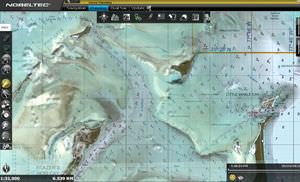
Display of electronic charts is standard equipment in inland
navigation. RADARpilot720° info provides this basic functionality.
However, AIS information is indicated, additionally.
RADARpilot720° info is offered as complete system including PC
and software. It can be upgraded easily for radar overlay, resulting
in an approved inland ECDIS navigation system.
- Display of chart, waterways and AIS information
- Convenient operation of the AIS transponder
- Complete setup including PC and software
- Trip computer
- Storing and export of screenshots
- Display of VHF channels relevant
- Compact measurements (22 x 9 x 27 cm)
- On-board power supply (24 V) or alternating current supply (230 V AC)
The system works utterly quiet on a state-of-the art industrial PC
without wear parts as there are rotating hard disk or fan.
|
|
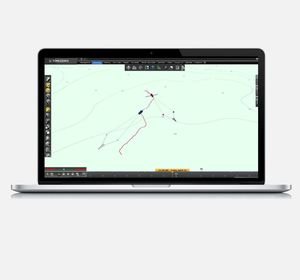
RADARpilot720° is a unique inland navigation system that coherently integrates radar with data of the global positioning system (GPS) and the electronic river chart ECDIS. At first glance, all essential information is available for the helmsman.
- overlay of radar and ECDIS chart
- download of current gauges
- display of depth and fairway
- extended chart coverage
- highly accurate position fixes by differential GPS
- rate-of-turn indicator
- recording function
- guidung lines
- trip computer mit VHF channel indication
- multi radar
- 26" screen
- Light Edition (LE) with AIS
|
|
|
The ARROW program is a software tool to estimate and display the potential conditions and countermeasures to Avoid Rolling Resonances Or Wave impacts on ships due to specific wave encounter situations. By means of the Main user interfaces (Fig. 1) the input of a small amount of data are needed to be entered into the areas of the Ship Parameter Input (top left side) and Wave Parameter Input (lower left side) to provid the results in the Result Display Area.
|
|
|
|
|
|
|
AutroMaster 5000 is a complete presentation system for control and monitoring of alarmed areas, and forms an integrated part of the fire detection system. A simple graphical user interface provides unprecedented control and monitoring of every point and on all detection loops. The system offers advanced functionality for many different applications. It is expansible, and is easily upgraded using built-in tools. AutroMaster 5000 provides a custom-tailored and fully dynamic colour graphic presentation of the premises. In the event of an alarm, the precise alarm location will be identified immediately and clearly. At a central point, fire and security personnel can easily follow the development of a fire by observing the colour changes on screen. In this way, they will always know precisely what is going on – and where, and the required actions can be taken. AutroMaster 5000 has a built-in report generator, providing cost-efficient documentation and maintenance logs.
AutroMaster 5000 allows users to easily disable and enable detectors, detector groups and analogue loop units, control programmable logical controllers (PLC), and operate emergency light systems.
|
|
Finally the shipping industry can reap the rewards of more than 60 years of combined knowledge in loading computers. Kockum Sonics presents LOADMASTER X5 (X stands for crossover) merging two solutions into the ultimate one. LOADMASTER X5 proves that the sum can be greater than the parts. Today Kockum Sonics possess a unique knowledge and experience in loading computer development, counting more than 8500 loading computer installations.
Kockum Sonics has no intentions in reducing the efforts in constantly pushing the envelope in loading computer development and co-operates closely with sailing masters, naval architects and classification societies in order to provide the best solution and meeting all the requirements in every case.
|
|
Why should you select SHIPMASTER?
Retrofits: Typically older vessels have automation systems
based on old technology and spare parts are rapidly becoming
scarce and expensive if not obsolete. A system failure can be
very costly. Apart from having a modern user interface and
advanced system capabilities our system is based on standard
PC components giving our customers access to spare parts at
very low prices with great availability.
|
|
The system allows the Master to continuously follow the
level gauging for each tank, and in addition volumes,
temperatures, weight, draft, trim and heel etc.
The program includes ship quantity reports, wedgeformula
and graphical display. This program can be delivered
installed in a Kockum Sonics workstation and it can also be
delivered in a network version for presentation in other
workstations onboard. The LEVELMASTER PRESENTATION
can communicate on-line data with an automation system
and/or LOADMASTER® or any other loading and stability
computer.
|
|
|
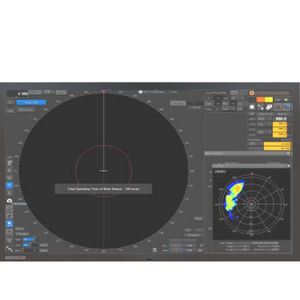
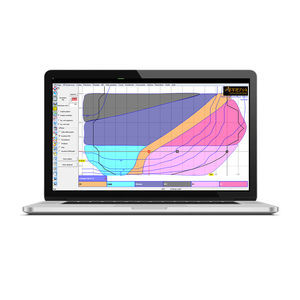
Combined polar display of responses and resonance zones. The speed of the vessel is plotted on the radius of the polar diagram. The point of the speed vector indicates the operating point of the ship. The diagram displays as a function of speed and heading in color the level of one response, or the envelope maximum of a combination of responses. An alarm is given to indicate exceed of one or more response criteria or risk for resonance at the actual combination of speed and heading. The resonance zones are constructed real-time according to the German SBG-guidelines for stability and can be applied as substitute for onboard paperwork.
|
|
|
The patent pending Maren - Marine Energy Management System is equipped with operational optimization, simulation-based decision support, extensive energy analysis tools and system controlling features. The system is a real-time energy management system that is located onboard the vessel and constantly improves performance
|
|
|
|
|
|
|
- Notifies the user of alarms generated by reefer containers
- Monitors alarm and temperature conditions including USDA cargo probes and special atmosphere readings
- Supports controller specific alarms and readings with all reefer manufacturers’ equipment such as Thermo King, Klinge/Sabroe, Carrier, Daikin, Mitsubishi and Starcool
- Shows the status of reefer containers in an intuitive graphical container plan
- Registers the history of each container and stores the data in a detailed log file
- Allows operator to send commands such as “defrost” and “change of set point” remotely
- Interfaces with a ship’s loading computer or a terminal planning system to transfer reefer container data and location automatically
- Interfaces with the Global Monitoring Server for centralized remote monitoring and system performance surveillance
- Forwards alarms by E-mail using a priority configuration
- Integrates a hand-held Remote Data Collector (RDC) for monitoring and documenting non-communicating reefer containers
- Integrates with hand-held LogMan for datalog retrieval, firmware upload and settings of reefer container controllers
- Displays reefer controllers’ software versions to ensure containers are kept up tp date
- Enables the operator to access REFCON from multiple workstations
- Features an easy to use on-line manual
|
|
|
|
|
|
|
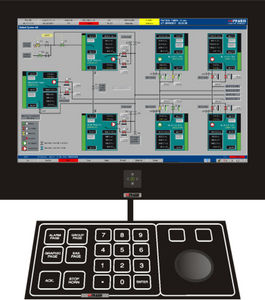
The Mega-Guard Cargo Control and Monitoring System fully automates the loading and unloading of Product Tankers and Chemical Carriers. Operator Workstations provide high resolution color graphic mimic overviews of cargo and ballast systems. Cargo pumps and valves are automatically controlled during loading and unloading of the tanker.
Operator Workstations
The cargo console is typically equipped with two or three Operator Workstations. The complete handling of the cargo and the ballast is executed from these Workstations.
Graphic mimic pages on the TFT Screen provide a detailed overview of the cargo and ballast tanks. A pump e.g., can be selected on the Workstation by pointing the pump with the Trackball. A pop-up menu appears and now the pump can be started and the required speed can be selected.
Operator Workstations can be delivered with Loading Computer software in order to alculate the shear forces and bending moments, the actual/ required stability and the damage stability calculations.
|
|
The NAPA Fuel Management System (NAPA FMS) enables easy and accurate fleet-wide reporting of fuel and energy consumption and management of related information.
The system consists of the NAPA Data Collection units onboard and NAPA Office ashore.
- User-friendly
- Direct input from shipboard systems means greater accuracy and prevents human errors
- Highly detailed fuel consumption reports
- Virtually unlimited amount of information can be included in the reports
- The actual consumption can be compared against budgeted or forecasted values.
|
|
|
|
|
|
|
Originally developed as a loading computer, Onboard-NAPA incorporates a wide range of features for loading calculations, hydrostatics, intact stability and longitudinal strength. Onboard-NAPA, however, is actually a much more versatile system than the average loading computer complying with the statutory regulations. Onboard-NAPA%u2019s strength lies in its advanced and unrivalled features for damage stability and decision support %u2013 features that make the system ideal for fast analysis of ship stability in emergency conditions, including grounding. This is why numerous well-known ship owners and operators rely on Onboard-NAPA.
The development of Onboard-NAPA was initiated in the early 1990s at Napa Ltd. The system has gained wide recognition among ship owners and operators in a relatively short time. During 1996, being the first year of active sales promotion of the system, some 40 installations were made. Today, Onboard-NAPA is being used onboard almost 900 ships, among them the world%u2019s most prestigious cruise liners.
The system is being applied widely to enhance ship safety, and it holds a track record of several real-life salvage operations involving a grounded ship. In these cases, Onboard-NAPA ensured the ship%u2019s safe refloating in a way that prevented further damage to the ship and averted danger to its crew. To read more, click on the Loading Computer link on the right.
|
|
|
|
|
|
|
MDS Manager is the fulcrum software that links all modules supplied by MARIS under the MDS banner. MDS Manager will run on any medium specification PC (MS Win XP O/S and MS Office preferred). MDS Manager communicates with dedicated MDS servers at the MARIS head office in Norway by email or VPN over the Internet. Data is encrypted and highly compressed to reduce airtime to a minimum. Duplicate servers at an independent location ensure a 24/7 continuous service.
The programme encompasses modules for:
Managing and updating paper charts on board
Managing and updating electronic charts on board
Planning routes, ordering charts and producing voyage plans
Managing UKHO Lists of Lights and Radio Signal
Ordering and displaying weather forecast information
Ordering and displaying port information
Ordering and displaying national and international marine related documentation
Other modules Managing and updating paper charts
MDS Manager is sent a weekly update for the UKHO paper catalogue charts plus thumbnail bitmaps of new charts. (The file size for this information is very small). The MDS Paper Chart Manager displays catalogue and chart update changes on a status page.
Managing and updating electronic charts
MDS Manager is sent a weekly update for the UKHO ARCS and ENC catalogues. (The file size for this information is very small). The MDS ARCS and ENC chart Manager displays catalogue and chart update changes on relevant status pages.
|
|
|
Omega Hyre Millennium is a Danish product and has been developed in co-operation among several Danish shipping companies and Soft-Team. More than 50 different shipping companies has already purchased the system.
|
|
Software to manage your fleet
In its 22 years of existence, the combination of a strong focus on the Maritime industry and dedicated employees with seagoing experience has enabled AMOS to become the world's leading maritime software provider. Today, over 12,000 AMOS licences have been sold to more than 1,200 companies in the maritime industry.
- Optimise your fleet management & control
- Increase your operational efficiency
- Comply with most IMO & ISPS regulations
The history of SpecTec and its AMOS (Asset Management Operating System) is the history of software at sea, thanks to over 20 years of dedication to Information Technology solutions for merchant ships, war ships and oil rigs.
|
|
|
Star Information Systems AS (SIS) is one of the pioneers (since 1967) and leading suppliers of maritime software for the marine and offshore industries. SIS was started by the people behind the SFI Group System and RAST PMS system. The software consists of tightly integrated solutions for marine planned maintenance, spares and purchasing, crew management, quality assurance, maritime insurance, guarantee claims, eCommerce and more.
|
|
Control and calculation software
To control and calculate the various data during liquid cargo handling and planning, API Marine has developed designated software, the API MasterLOAD™. Supplied with real-time data, this software makes it possible to keep the operator up-dated at all times with cargo conditions, tank and loading status in addition to Stability and stress, damage stability and Squat effect.
API MasterLOAD™ software is designed for:
- Making cargo plans
- Update the state of the cargo during a voyage
- On-line and Off-line calculation of weight, draughts, stability and stresses,
- damage stability and squat effect
|
|
The system consists of a series of planned maintenance job cards (PM JobCard), covering the vessels equipment. Each PM JobCard consists of 3 major elements:
* A set of up to 6 job routines each of which contains the maintenance instructions for a particular task
* The maintenance schedule for the job routines, consisting of interval and next due date or hours. Intervals can be calendar, hours or events such as dry dock
* A history record of previous PM job completion reports and directly entered comments
|
|
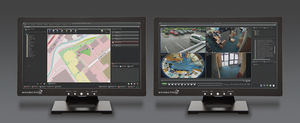
HERNIS Sea Touch is a windows-based intuitive user interface adding Touch-screen functionality to your CCTV system.
Map-based selection of cameras makes it easy to identify and select camera stations on the site by touching the screen. Activated alarms are automatically flagged on the map, enabling instant visualisation of the critical location. Alarms are akcnoledged locally directly on the screen when the appropriate measures have been taken.
|
|
|
|
|
|
|
AutroMaster 5000 is a complete presentation system for control and monitoring of alarmed areas, and forms an integrated part of the fire detection system. A simple graphical user interface provides unprecedented control and monitoring of every point and on all detection loops. The system offers advanced functionality for many different applications. It is expansible, and is easily upgraded using built-in tools. AutroMaster 5000 provides a custom-tailored and fully dynamic colour graphic presentation of the premises. In the event of an alarm, the precise alarm location will be identified immediately and clearly. At a central point, fire and security personnel can easily follow the development of a fire by observing the colour changes on screen. In this way, they will always know precisely what is going on – and where, and the required actions can be taken. AutroMaster 5000 has a built-in report generator, providing cost-efficient documentation and maintenance logs.
AutroMaster 5000 allows users to easily disable and enable detectors, detector groups and analogue loop units, control programmable logical controllers (PLC), and operate emergency light systems.
|
|
SODENA LOGBOOK CDP3000 is the efficient combination of a logbook and a scale - an ideal solution wich allows saving time and improving working methods.
- Manual or automatic catch recording with a scale
- Absolute reliability of storage in database
- International Codes
- Consultation of stored fishery data in real time
- Facilitated and rationalized management of catches
- Fishing efforts report editing
|
|
|
|
|
|
|
NAPA Log is a platform for Electronic Logbooks
The NAPA Log consists of two components: a Ship Module and the Office Module. The Ship Module is for gathering, entering and relaying data to the Office Module. The Office Module is a system for receiving, viewing and storing the data received from ship systems. It builds up a fleet-wide database for reporting the data received.
NAPA Electronic Logbook - To replace traditional logbooks
The Ship Module of the NAPA Log is the main component of the electronic logbook system. It records all traditional logbook data in great detail with a minimal amount of user input. The system has online interfaces to navigation and vessel automation systems. The amount of logged data is limited only by the onboard systems.
All of the data entered into the electronic logbook is authenticated and cannot be altered afterwards; the Ship Module data are thus considered a replacement for traditional logbooks. Proper back-up routines ensure that the data is stored securely for an extended period. Initially the system includes all data fields found in traditional logbooks. The system is structured in such a way that additional data (e.g. company-specific logbooks, etc.) can be incorporated with relative ease.
From the ships, the logbook data are transferred to the Office Module for viewing and further processing. The electronic logbook data can be used for various reports and follow-up of performance.
|
|
|
|