|
|
|
|
|
|
|
Bio Sludge Treatment System
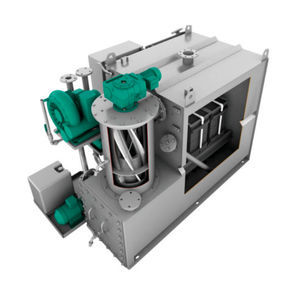
In the Bio sludge Treatment System all sludge from waste water and food waste is processed. The system is tailor made to secure the interface between liquid and solid sludge before final incineration.
The main target for the bio sludge treatment system is to reduce volume by dewatering, drying and to disinfect. Sludge from waste water and food waste represents a large volume that needs further treatment To align with the environmental requirements for no pollution at sea, the need for a sludge treatment process onboard is obvious.
Dewatering of sludge increases dryness up over 20% reducing the volume 90%. The reject water from the dewatering is treated in the Scanship waste water system.
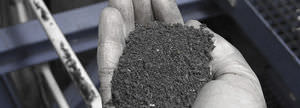
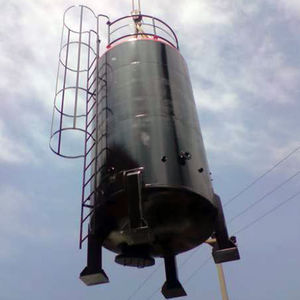
To increase the dryness further, all dewatered sludge is treated in a drying process. The process increases the dryness up to 60%, making the solids burnable. Dried sludge is stored in the silo separately from the burnable garbage to prevent fire. The drying process increases temperature up to a level where all bacteria will be killed. The end product is free from odour and the risk of contamination has been eliminated.
|
|
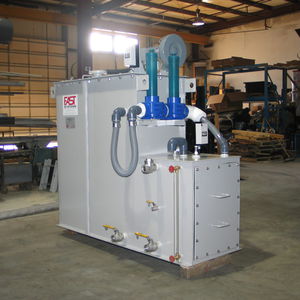
During the bilgewater separation process impurities accumulate in the sludge space. They are discharged into the sludge tank at periodic intervals by means of total bowl ejections. The self-cleaning bowl is equipped with the modern hydrostop system. The result is highly compacted solids.
An intelligent control and monitoring system assures problem-free, round-the-clock unmanned operation. It also ensures that only water with an oil content lower than 15 ppm is released into the environment.
|
|
The sludge components of water, oil and solids are separated in the separator by centrifugal force. The recovered oil and water is discharged under pressure by centripetal pumps.
The concentrated sludge is discharged intermittently via the sludge transfer unit into a heated sedimentation tank where final concentration takes place. Excess water and oil is allowed to overflow back to the sludge tank.
The concentrated sludge is pumped from the unit automatically by a solids discharge pump controlled by a level switch.
Amicroprocessor-based control cabinet supervises and controls the complete concentration process.
|
|
The VARIMAX decanter centrifuges are specially designed and adapted to marine use in connection with the removal of solid matter from sludge.
A central feature in the design of the decanter is the spring mounted main bearing system, that permits super critical speed of the decanter bowl. Super critical operation ensures that any unbalanced force will disappear before it reaches the main frame, resulting in operation without vibration and noise and with minimal loading of the bearings.
The super critical operation further more permits a much slender design of the rotor components, giving long bearing life and a relatively high capacity compared to traditional decanters of the same size.
The capability of our decanters is fully proven, and our decanter units have to date been installed and are in operation in more than 75 vessels world wide. The total operating experience exceeds 100.000 hours.
|
|
|
|
|
|
|
Bio Sludge Treatment System
In the Bio sludge Treatment System all sludge from waste water and food waste is processed. The system is tailor made to secure the interface between liquid and solid sludge before final incineration.
The main target for the bio sludge treatment system is to reduce volume by dewatering, drying and to disinfect. Sludge from waste water and food waste represents a large volume that needs further treatment To align with the environmental requirements for no pollution at sea, the need for a sludge treatment process onboard is obvious.
Dewatering of sludge increases dryness up over 20% reducing the volume 90%. The reject water from the dewatering is treated in the Scanship waste water system.
To increase the dryness further, all dewatered sludge is treated in a drying process. The process increases the dryness up to 60%, making the solids burnable. Dried sludge is stored in the silo separately from the burnable garbage to prevent fire. The drying process increases temperature up to a level where all bacteria will be killed. The end product is free from odour and the risk of contamination has been eliminated.
|
|
During the bilgewater separation process impurities accumulate in the sludge space. They are discharged into the sludge tank at periodic intervals by means of total bowl ejections. The self-cleaning bowl is equipped with the modern hydrostop system. The result is highly compacted solids.
An intelligent control and monitoring system assures problem-free, round-the-clock unmanned operation. It also ensures that only water with an oil content lower than 15 ppm is released into the environment.
|
|
|
|