


{{product.productLabel}} {{product.model}}
{{#if product.featureValues}}{{product.productPrice.formattedPrice}} {{#if product.productPrice.priceType === "PRICE_RANGE" }} - {{product.productPrice.formattedPriceMax}} {{/if}}
{{#each product.specData:i}}
{{name}}: {{value}}
{{#i!=(product.specData.length-1)}}
{{/end}}
{{/each}}
{{{product.idpText}}}
{{product.productLabel}} {{product.model}}
{{#if product.featureValues}}{{product.productPrice.formattedPrice}} {{#if product.productPrice.priceType === "PRICE_RANGE" }} - {{product.productPrice.formattedPriceMax}} {{/if}}
{{#each product.specData:i}}
{{name}}: {{value}}
{{#i!=(product.specData.length-1)}}
{{/end}}
{{/each}}
{{{product.idpText}}}


Output power: 20, 150, 60, 100 W
Transmission frequency range: 2 MHz - 28 MHz
Reception frequency range: 500 kHz - 30,000 kHz
... button to send an automated digital Distress signal. The digital distress signal with GPS coordinates calls for help from other ships or coast stations. Built-in DSC Watch-Keeping Receiver with the Multiple Task Mode The dedicated ...
Icom
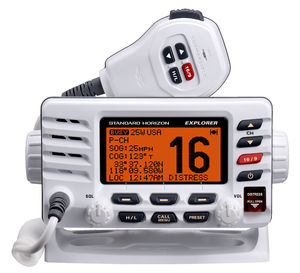

... Mounting a VHF radio has never been easier. The Explorer GX1600 has an ultra thin, compact rear case, only 3.5” in depth or half the depth of comparable VHF radios on the market. Ultra ...
Standard horizon
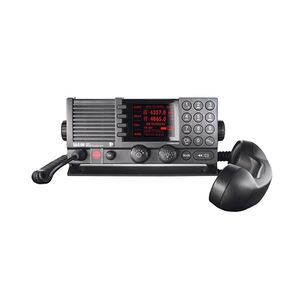

... variety of vessels SAILOR 6350 MF/HF DSC Class A is a rugged, high-end communications system in its own right. It complies with the newest requirement - ITU493-13 - for MF/HF DSC Class A, part of the mandatory requirements for SOLAS ...
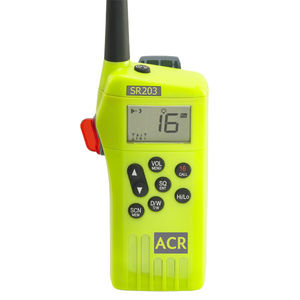

Output power: 2.5 W
Number of channels: 16 unit
Weight: 0.4 kg
... assistance, the SR203 VHF is easy to use. Once it’s been activated, this survival radio automatically tunes to emergency Channel 16, and has a single push call button so you can quickly send out your distress message. ...
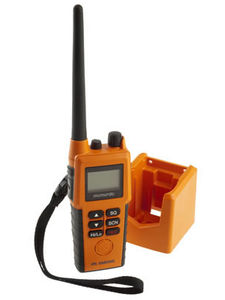

... The R5 is the ideal solution to meet the stringent GMDSS safety standards for compliant vessels. More than just an emergency radio, the R5 is packed with features, can be easily used even when wearing gloves and its rugged waterproof ...


Output power: 2.5, 1 W
Number of channels: 21 unit
Height: 141 mm
... attached to the radio without fear of losing its charge. The radio will always be available for use in times of emergency without the need to remove protective labels or the like before use. Simply break off the red protective ...
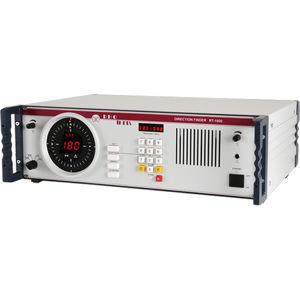

... immediately assign radio messages to the right targets on the radar display. The RT-1000 is also suitable for stationary VTS applications to control the vessel traffic close to the coast. Special Features High-precision ...
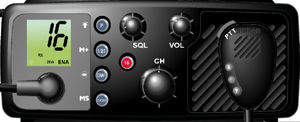

... Features : display and button backlighting user channel channel transmit power 1 or 25W dual watch and tri-watch modes scan scan of selected channels squelch, volume and channel rotary controls fistmike with PTT (push-to-talk) and select channel buttons ...
MI Simulators
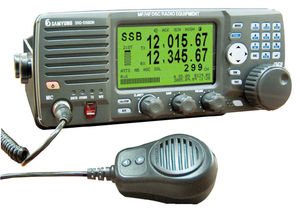

... Features • Compliant with ITU, IMO and GMDSS standard. • Adoption of new conceptual SYNTHESIZER technology improves voice quality, no-nosie. • Compact size and simplified key and dial enables to operate efficiently. • Realization of dual display for ...
Navis USA LLC
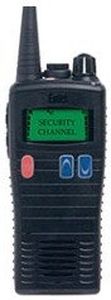

... technology, these marine portables give you the option of displaying a battery cycle count each and every time you power-on your radio. For your convenience it will even alert you to imminent battery life expiration. The commercial ...
Entel
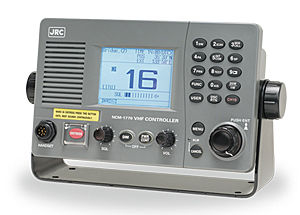
A ships radio is capable of voice communication over great distances. NauticExpo offers different ship radio systems classed by frequency range including VHF, HF, MF and UHF.
ApplicationsThese radios enable radiotelephone contact between distant stations on a set frequency, or channel. They provide practical ship-to-ship or ship-to-shore communication.
TechnologiesSuch a radio has at least one semi-duplex channel, a predetermined frequency on which the user can transmit and receive, though not simultaneously. Full duplex models can send and receive at the same time. Some include digital selective calling (DSC) capability.
How to chooseChoice will depend on the radio's range and the vessel's zone of operation. The IMO and government agencies establish minimum requirements for radio communications equipment in different zones. For example, ships sailing in zone A1 must have at least a VHF radio capable of transmitting a DSC message on channel 70.
- Voice communication
- Instantaneous communication
- Subject to interference
- Limited range
the best suppliers