


{{product.productLabel}} {{product.model}}
{{#if product.featureValues}}{{product.productPrice.formattedPrice}} {{#if product.productPrice.priceType === "PRICE_RANGE" }} - {{product.productPrice.formattedPriceMax}} {{/if}}
{{#each product.specData:i}}
{{name}}: {{value}}
{{#i!=(product.specData.length-1)}}
{{/end}}
{{/each}}
{{{product.idpText}}}
{{product.productLabel}} {{product.model}}
{{#if product.featureValues}}{{product.productPrice.formattedPrice}} {{#if product.productPrice.priceType === "PRICE_RANGE" }} - {{product.productPrice.formattedPriceMax}} {{/if}}
{{#each product.specData:i}}
{{name}}: {{value}}
{{#i!=(product.specData.length-1)}}
{{/end}}
{{/each}}
{{{product.idpText}}}


... delayed OPEX Data-enabled services Simple and instant visual of turbocharger and engine performance 24/7 access to customer portal Ready for other digital services Enhanced turbocharger cut-out ...
Accelleron

High efficiency turbocharger for two-stroke diesel engines Featuring high efficiencies, high pressure ratios and exceptionally wide compressor maps, the A100-L and A200-L series of advanced single-stage turbochargers ...
Accelleron

... Accelleron’s latest single stage turbocharger, targeting the newest generations of low speed two-stroke engines operating on both diesel and gas fuels. Building on the success of the A100-L, the outstanding turbocharger ...
Accelleron

Engine power: 5,500 kW - 12,000 kW
... compressor maps The A100-M turbochargers are designed for medium-speed engines in marine and stationary application with power output from 500 to 6,000 kW output per turbocharger (1000 to 12,000 kW ...
Accelleron

Engine power: 500 kW - 6,000 kW
The turbocharger of choice for high performing four-stroke medium speed engines Our A100-M turbochargers are designed for both main and auxiliary medium-speed engines, in heavy-duty applications ranging ...
Accelleron

Engine power: 600 kW - 2,000 kW
... MXP is a dedicated turbocharger with a simplified design, offering great value to engine builders and operators of marine auxiliary engines with a power output of up to 2MW. Dedicated turbocharger First ...
Accelleron
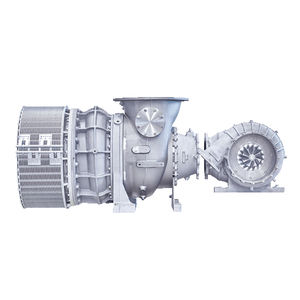
... Power2-800 M, the second generation of Power2 is not only the most efficient four-stroke turbocharger yet to be experienced, it is also the most compact turbocharger of its kind. Space is a premium in ...
Accelleron

Engine power: 400 kW - 3,300 kW
Powerful and compact The TPS-F turbocharger is compact turbocharger for small medium-speed diesel engines, large high-speed diesel engines and gas engines in the power range from 400 kW to 3,300 kW. The ...
Accelleron
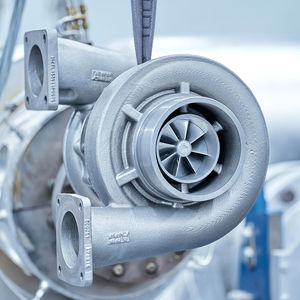
Engine power: 1,000 kW - 3,500 kW
... the TPX turbocharger Robust design to tackle demanding operating profiles: The TPX turbocharger has been built based on field-proven features and a reduced number of components and functional interfaces. ...
Accelleron

Engine power: 500 kW - 6,000 kW
... helps reduce fuel consumption at high engine power. The A100-H can be used on power generation applications, gas compression, ships, rail and off-road vehicles. Benefits Significant increase in mean engine power ...
Accelleron


Engine power: 8,500 kW - 23,900 kW
With the TCX series, MAN Energy Solutions has developed a turbocharger especially suited to two-stage turbocharging of four-stroke diesel and gas engines.
MAN Energy Solutions - Marine

Engine power: 5,400 kW - 32,400 kW
MAN TCA turbochargers are high-performance solutions characterized by simple maintenance and long overhaul intervals.
MAN Energy Solutions - Marine


... experience and technology in manufacturing engines and precision machinery, HHI-EMD produces exhaust gas turbochargers under a technical tie-up with ABB Turbo Systems and Mitsubishi Heavy Industries (MHI).
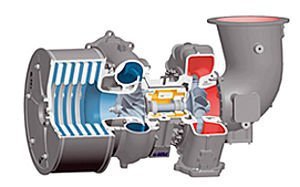
A turbocharger is a turbine device used to compress the air needed by an internal combustion engine. NauticExpo offers axial and radial models and turbochargers with air coolers, among others.
ApplicationsThese devices are often used on diesel engines to balance the air-fuel mixture. They increase engine power and performance.
TechnologiesThe three main types of turbocharger differ in their flow configuration: radial, axial and diagonal. All use the engine's exhaust gases to spin a turbine which drives an air compressor. The compressed air fed to the cylinders at higher pressure increases engine performance.
How to chooseFluid compressibility must be considered. Centrifugal, or radial turbochargers are more durable, have a wider operating range and are easier to fit with an air cooling system than axial models. In contrast, axial turbochargers are more compact, run at higher speed and give better performance.
- Low maintenance
- Compact
- Little wear
Please specify:
Help us improve:
remaining