


{{product.productLabel}} {{product.model}}
{{#if product.featureValues}}{{product.productPrice.formattedPrice}} {{#if product.productPrice.priceType === "PRICE_RANGE" }} - {{product.productPrice.formattedPriceMax}} {{/if}}
{{#each product.specData:i}}
{{name}}: {{value}}
{{#i!=(product.specData.length-1)}}
{{/end}}
{{/each}}
{{{product.idpText}}}
{{product.productLabel}} {{product.model}}
{{#if product.featureValues}}{{product.productPrice.formattedPrice}} {{#if product.productPrice.priceType === "PRICE_RANGE" }} - {{product.productPrice.formattedPriceMax}} {{/if}}
{{#each product.specData:i}}
{{name}}: {{value}}
{{#i!=(product.specData.length-1)}}
{{/end}}
{{/each}}
{{{product.idpText}}}


Product name : ORCA® Hardener for Neoprene Glue - ORCA® HARNDENER RFE Description : ORCA® HARNDENER RFE Hardener is specially designed to reinforce the bond strength of assemblies when using ORCA® ...
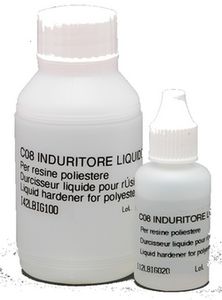

C08 LIQUID HARDENER Cicloesanone peroxide. Use 1-3%.
ICR
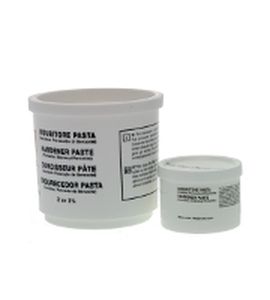
C10 PASTE HARDENER FOR POLYESTER PRODUCTS Benzoyl peroxide use at 1-3%.
ICR
Please specify:
Help us improve:
remaining