|
|
|
|
|
|
|
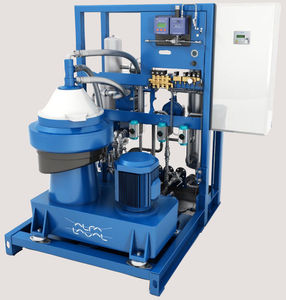
The EcoStream oily water treatment system combines two Alfa Laval core technologies into a fully automated system for cleaning oily waste water aboard ships and marine installations, as well as at land-based power plants and other facilities.
Cleaning oily waste water, both at sea and on land, often involves separating complex mixtures of oil, water and solids, sometimes in large volumes. To comply with increasingly stringent environmental legislation, these have to be treated before disposal.
Most conventional technologies are incapable of effectively splitting the kinds of stable emulsions often found in such kinds of oily waste water, or of removing suspended colloidal particles.
However, high-speeed centrifugal separation using the EcoStream oily water cleaning system has proven a reliable, efficient and versatile way to ensure continuous removal of oil and other contaminants in the bilge water on board ships, drilling rigs and other marine installations, and at land-based power plants.
The EcoStream is a complete stand-alone system that is easy to install in any new or existing installation. The compact, modular design saves time, space and money, with no need for manpower and downtime to replace filter elements. There is less need for large holding tanks, and space becomes available for other operations or cargo.
Automated control and monitoring provide continuous fully automatic operation, capable of cleaning oily waste water to less than five parts per million (ppm) oil in water. It operates at flow rates of up to 2,000 litres per hour, to meet even the most demanding requirements.
|
|
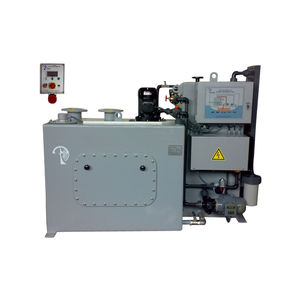
The new bilgewater treatment system with the Westfalia Separator minimaXx separator type WTC was specially designed for the rough conditions on board.
The product is fed by the feed pump into the centre of the separator bowl. Within the rotating bowl, the product is separated into a heavy and light phase.
The heavy water phase is separated from the finest oil droplets and dirt particles and then conveyed under pressure by the centripetal pump to the discharge. If the oil concentration on the clean water outlet of the centrifuge exceeds 15 ppm the water is led through an absorption filter. The lighter oil phase flows to the centre of the bowl and is discharged by gravity.
The separated sludge is collected in the solids holding space and must be removed by hand. An intelligent control and monitoring system assures problem-free, round-the-clock unmanned operation. It also ensures that only water with an oil content lower than 15 ppm is released into the environment.
|
|
Bilge water cleaning
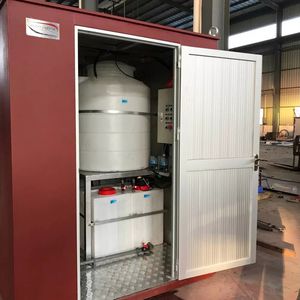
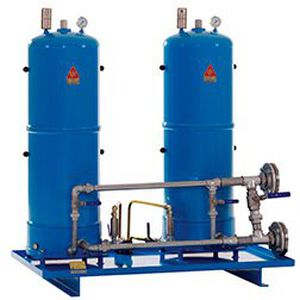
With Marinfloc Emulsion Breaking Bilge Water Cleaning System (EBBWCS), you can clean bilge water cost-effectively. For less than USD 3 per cubic meter of cleaned water, you can meet the international requirements.
The equipment if fully automated with a constant-flow bilge water cleaning system. The water content in the residue is kept to a minimum, in order to keep the cost of handling the residue to a minimum.
|
|
The product (i.e. oily water) is sucked up from the oily water tank or engine room bilge and fed by the feed pump through the filter and preheater via the feed valve to the separator. During the start-up or ejection program it is led back into the oily water tank. The product flows from above into the centre of the separator bowl. The heavy water phase is separated from the finest oil particles and then conveyed under pressure by a centripetal pump to the discharge.
The separated impurities accumulated in the sludge space are discharged into the sludge tank periodically. The clean water discharge is supervised by an oil monitor and discharged into the environment. If the oil content exceeds 15 or 5 ppm the water is recirculated into the oily water tank. An intelligent process control adapts the capacity of the system to the changes of the product.
|
|
During the bilgewater separation process impurities accumulate in the sludge space. They are discharged into the sludge tank at periodic intervals by means of total bowl ejections. The self-cleaning bowl is equipped with the modern hydrostop system. The result is highly compacted solids.
An intelligent control and monitoring system assures problem-free, round-the-clock unmanned operation. It also ensures that only water with an oil content lower than 15 ppm is released into the environment.
|
|
| ... products without information |
| |
During the bilgewater separation process impurities accumulate in the sludge space. They are discharged into the sludge tank at periodic intervals by means of total bowl ejections. The self-cleaning bowl is equipped with the modern hydrostop system. The result is highly compacted solids.
An intelligent control and monitoring system assures problem-free, round-the-clock unmanned operation. It also ensures that only water with an oil content lower than 15 ppm is released into the environment.
|
|
|
|