|
|
|
|
|
|
|
When ships take on ballast, they take on more than water. Microscopic organisms, eggs, cysts and even the planktonic larvae of larger organisms are small enough to pass through the intakes and pumps.
If these organisms survive transport to other parts of the globe, their impact can be devastating. In seas that are weakened by overfishing, contaminants and pollution, non-native species can reproduce quickly and deprive local species of food and living space.
Such invasions can jeopardize the health and economy of the local population, and their effects are usually irreversible. IMO has identified the introduction of species via ballast water as one of the four greatest threats to the world's oceans.
In 2004, the organization adopted the International Convention for the Control and Management of Ships' Ballast Water and Sediments, which will phase in requirements for ballast water treatment over the coming years.
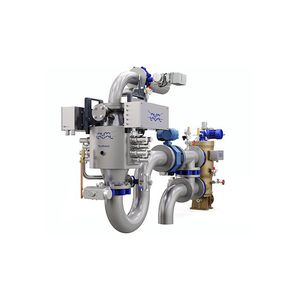
PureBallast from Alfa Laval
PureBallast is an easy-to-use ballast water treatment system that meets the new IMO requirements. Unlike many proposed systems, which rely on chemicals or are too large to implement in real life, PureBallast involves no environmental or operational compromises. Using a unique, chemical-free technology, PureBallast produces radicals that neutralize organisms in ballast water.
|
|
|
|
|
|
|
Around the world more than 10 billion tons of ballast water are carried in ships each year containing thousands of species of aquatic animals and plants. This creates problems for the marine environment and human health and threatens economies that depend on healthy aquatic ecosystems. The transportation of ballast water can not be stopped, but the transfer of harmful aquatic organisms and pathogens can be minimized by deep sea exchange or suitable treatment. Ballast water exchange is costly, time consuming and is at best only 90% effective. Pumps may have to run for 3-4 days, which increases fuel consumption, and wear and tear on equipment and stack emissions. Ballast water exchange can result in increased hull stresses and stability problems.
Hyde Marine Ballast Water Treatment System
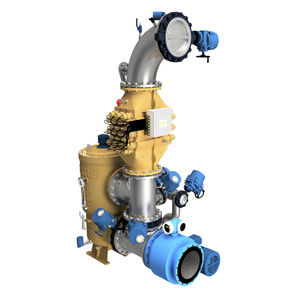
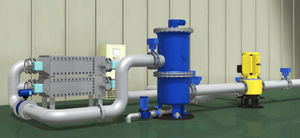
The Hyde Marine BWTS offers an effective and reliable solution based on solids separation and UV irradiation. The Hyde Marine system utilizes existing ballast pumps and piping. Standard systems are available for flow rates from 60m3/h up to 1500m3/h and customized systems up to 6000m3/h.
The Hyde Marine BWTS is optimized for each particular vessel design and operating conditions. The system includes appropriate pretreatment to remove solids and large organisms. For smaller ballast systems and applications where high solids removal is desired, the Hyde Filter is economical and practical. The Hyde UV destroys or inactivates biological organisms including zooplankton, algae, bacteria and pathogens from ballast water without affecting the normal operation of the ship. Ballast water is also treated during de-ballasting to ensure the maximum effect.
|
|
|
|
|
|
|
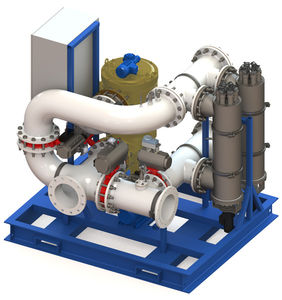
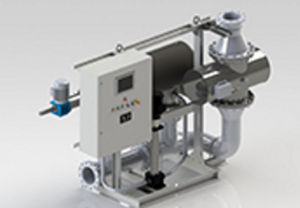
The Type Approved OptiMarin Ballast System (OBS), is based on solid separation (filter) as pre-treatment and high doses of UV irradiation for inactivation of marine organisms, viruses and bacteria, without affecting the normal operation of the ship. Ballast water is UV treated both during ballasting and de-ballasting to ensure the dual UV effect. Ballast water is only filtered during ballasting.
The OptiMarin Ballast System (OBS) can easily be installed in existing or new ships and can handle flows up to 7000 m3/h. The MicroKill Medium Pressure UV can handle almost any flow when multiple reactors are built into a manifold system.
The components in the OptiMarinSystem are flexible; the installation is normally in the pump or engine room and in close proximity to the ballast pumps. The OptiMarin system uses existing ballast pumps, is small and modular, and does not restrict flow.
For certain ship types and for retrofit, the system can be delivered in a container including a booster pump for easy installation on deck or other available spaces. A skid solution can also be provided upon request.
|
|
|
|
|
|
|
For many years the discharge of untreated ballast water in the port of destination has caused serious ecological and economic damage and harm to public health. Organisms in ballast water find themselves in an alien environment, one where the absence of their natural enemies means they can multiply rapidly and threaten the ecological balance. With the adoption of the Convention on Ballast Water Management the International Maritime Organisation (IMO) has reacted to the problem, which has been known of for some years. In future ballast water must be treated on-board to reduce the number of living organisms to a minimum. The convention applies from 2010, although there are transitional arrangements which depend on the keel laying date and the capacity for ballast water. These arrangements cover the retrofitting of existing ships up to 2016.
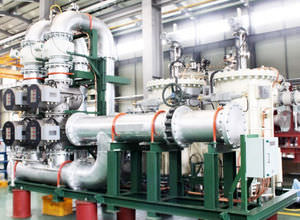
RWO has developed CleanBallast, a technology for onboard treatment of ballast water which reliably removes organisms, sediments and suspended solids in just two steps:
%u2022 A DiskFilter system for mechanical separation when taking in ballast water,
%u2022 followed by our advanced EctoSys® disinfection unit which, without any addition of chemicals, further reduces the number of living organisms before reaching the ballast water tanks.
|
|
|
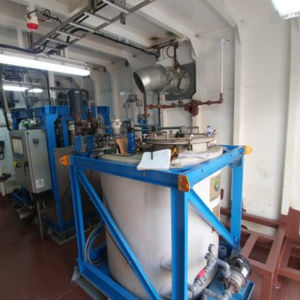
Auramarine has dedicated significant amounts of time and funds to develop a BWT System that can cope with the requirements of various ships and harbours. In the Crystal Ballast project, Auramarine had four main goals: the company was determined to provide the best practical solution for shipowners and yards around the world. The project also strived for comprehensive understanding of ballast water conditions and flows onboard ships, and aimed at a system that could be adjusted and fitted for various vessel types and ballasting operations. Finally, the product had to be competitive as regards its size, weight, energy consumption and cost-effectiveness, both at the time of installation and in operation.
|
|
|
From the vessels sea chest, the ballast water is pumped onboard and filtered before exposed to extreme pressure pulses in the C3-T cavitation chamber. Immediately following cavitation, the water is supersaturated and disinfected by injecting an onboard produced mixture of nitrogen and activated water. Filtered, cavitated, supersaturated and hypoxic water enters the ballast tanks - which are equipped with pressure/vacuum control systems preventing nitrogen leakage from the tank as well as contamination of air into the tanks – preventing potential re-growth and significantly reducing oxidation of tank surfaces - and thereby corrosion and weathering of coatings.
|
|
Invasive aquatic species are one of the greatest environmental threats to the world's
oceans. Scanship Environmental is preparing for the new IMO rules for Ballast
Water valid from 2009 by offering the highly acknowledged OceanSaver® Ballast
Water Management System for the Cruise and Ferry Industries.
Scanship Environmental - A trusted supplier of recognized water and waste
treatment solutions to the passenger fleet through 15 years!
|
|
|
|
|
|
|
Ozone is formed naturally in the atmosphere, as a colorless gas having a very pungent odor. Ozone is an unstable gas that decomposes readily into molecular oxygen. Ozone is the most powerful and rapid acting oxidizer produced, and will oxidize all bacteria, endotoxins, mold and yeast spores, organic material and viruses
The conversion of oxygen into ozone occurs with the use of ambient air and energy. This process is carried out by an electric
discharge field. Nitrogen is stripped from ambient air to concentrate the oxygen content and Oxygen is passed through a high voltage or high frequency electrical field. A percentage of the oxygen are converted to ozone.
Ozone kills a percentage of invasive marine species by direct contact. The remainder of the invasive marine species are killed when the ozone interacts with other chemicals that naturally occur in sea water to create hypobromous acid. This kills the remaining invasive marine species.
Both ozone and the hypobromous acid then disintegrate so there will be no damage to the receiving water into which the treated water is discharged. Only trace amounts of the bromine compounds remain in the treated water. Those trace amounts enable the ship's captain to prove to the port authority that the ballast has been properly treated.
|
|
| ... products without information |
| |
|
|